Showing posts with label Graphic Novels. Show all posts

Monday, June 30, 2014

Book Review: X-Men: Battle of the Atom

X-Men: Battle of the Atom is the kind of time-travel mess you can only get in comic books. Hank McCoy has brought the past X-Men forward to meet the current group and encourage them to regain their idealism. Unfortunately for him, instead of inspiring their older selves and going home, the group promptly split up, with Angel going to join Evil Cyclops and others opting to stay in the current school. Now, the X-Men from the future come back and claim that their younger selves have to go home at once. Current X-Men argue about whether or not the past folk should have a say in matters, past X-Men doing some more splitting up, and Future X-Men chasing everyone. Marie Hill gets to rant about Hank McCoy being the real loose canon among the mutants, all sorts of chaos and mayhem ensues, and there is great confusion amidst the ranks. It's crazy, it's fun, and this kind of merry mayhem one of the reasons I read comic books.

It's not perfect, but it is great fun, with tons of chronal chaos, misunderstandings, and mix-ups going on. Watching three Beasts interact, or seeing younger Iceman face not one, but ultimately three, versions of his future self makes for some fun character moments. And did I mention Hill's tirade? Just the sheer, unadulterated ridiculousness of the situation alone is worth reading for.

The various artists and writers between them do an excellent job of keeping the individuals distinctive. There were a lot of people to track, but they were easy to track: I never found myself stopping and wondering "Now who was that again?" Ok, I did, but only for some of the really, really minor bystanders in the back--and one of them asks the same question, so that's ok.

The not perfect part? I am afraid I'm getting a little tired of "the-world-that-hates-and-fears-them," which is pretty much the X-Men's primary characteristic, and while that was not the central point of the issue, which focused primarily on the aforementioned chronal troubles, it did come up more than once. Unfortunately, this means I may have to bow out of the X-books entirely fairly soon, which would be sad. I may be intermittent in my following now, but the X-books were my first entry into comic books. Also, I'm still not really buying Evil Cyclops, especially because I've read the whole story, which involved more contrivances than I can swallow. Still and all, I enjoyed the volume, and I'm glad Beast brought the past people forward, even if Maria Hill is not.

The book will primarily appeal to people who already have some working knowledge of the X-verse, I think. There are a few to many versions of a few too many people running around for it to be an easy entry point.

Publication Information
Writers: Brian Michael Bendis, Brian Wood, Jason Aaaron
Artists: Frank Cho ,Stuart Immonen , David López , Chris Bachalo, Esad Ribic, Giuseppe Camuncoli , Arthur Adams
Published: January 21st 2014 by Marvel
ISBN: 0785189068 (ISBN13: 9780785189060)

Book Review:Uncanny Avengers Vol. 1: The Red Shadow

Sometimes, I expect to enjoy a book, and then I just don't. Uncanny Avengers: The Red Shadow is one of those times. In an attempt to change the world's view of mutants, Captain America has put together a new team of Avengers, one that mixes mutants and "regular" Avengers. Their first foe in this issue is the Red Skull who has grafted Xavier's brain onto his own and is using his new ability to whip up anti-mutant frenzy and rioting as—I guess—a step toward taking over. Essentially, the new team is faced with their worst nightmare: Captain America's long-time foe, Xavier gone bad (again), and anti-mutant rioting. Rick Remender has written some really good stuff in the past(1), and the Uncanny Avengers holds the potential to take the X-folk off into some new territory, so I was ready to enjoy the book.

Sadly, I spent most of it wishing everyone would just shut up. Alex Summers makes a speech. Rogue and the Scarlet Witch snipe at each other. The Red Skull talks. And talks. And talks. He now has the power to influence people's minds directly, and while he does that, he apparently cannot resist making endless speeches. I ended up skimming a lot of his verbiage which left the rest of the book rather slim pickings: oodles of fight scenes as waves of rioters turn on the Avengers, the X-Men, and each other.

I was disappointed with the main plot as a whole: The team mixup also provides an opportunity to do something new with the X-Men. Instead, they're still facing the same old "World-that-hates-and-fears-them."

So, no go here. X-Men enthusiasts might want to read the first bit where Alex makes his infamous "Don't call me a mutant" speech. Otherwise, read X-Men: Battle of the Atom instead.

(1)The not too distant past: I cannot begin to say how much I loved Black Science, though I do try over onFanboyNation. Seriously, that book is incredible.

Publication Information
Hardcover, 136 pages
Published April 24th 2013 by Marvel
ISBN 0785168443 (ISBN13: 9780785168447)
Uncanny Avengers (Marvel NOW!) Vol. 1: 1-5

Monday, May 19, 2014

Rereading Astro City

The Astro City books are not books on my forever-and-always-reread shelf (yet, anyway); they're books I keep wandering back and rediscovering. "Oh, Astro City," I'll say to myself as I wander through the library, "I rather liked those."

And then I'll pick them up, and wham! There I'll be, immersed in them, admiring them, and daring anyone to say bad things about them—or even ever-so-slightly-critical things1.


Why do I love them? For starters, they're about the city, the whole, big, wonderful, bustling place. That means I get to wander around and find all sorts of places, and even better, the narrative wanders. Various stories are told from the point of view of: a doorman as he watches city life go by, speculates on which of the tourists might come back to live, and remembers the time he was a hero (not the super-powered sort; the other kind); the boy who becomes the Confessor's sidekick; a former would-be super-villain trying to build a new life; a grumpy alien trying to decide whether or not his people should invade Earth; a heroine who looks like a fashion doll and cannot remember who made her—you get the idea. It's a varied list, and it has texture. Oh, and I love Shadow Hill, a place so strange even most Astro City folk look at it sideways.


For another, Busiek knows how and when to go small: The alien is grumpy when he shows up. Not menacing, not overwhelmingly powered or mystical, but every day, common grumpy. He kind of likes Earth, but then again, people can be so annoying… He's an ordinary alien, just someone doing his job. That doesn't make him harmless, but it does make him—real? Relatable? (Kind of scary, when you think about it, but pretty awesome, too). And Crackerjack, one of the superheroes, is just plain old vain. A friend (the one who introduced me to Astro City, in fact) once asked why I liked that so much. It's because then—and even now—most heroes tend to have outsized personalities; they brood more intensely than anyone else; they don't just get a bit touchy, they have berserker rages; on bad days, they destroy cities. Even the modern, "realistically" flawed superheroes tend to go overboard in a movie-star kind of way. It's nice to see someone who is just plain vain, a nice, ordinary, annoying kind of flaw.

Also, they're beautiful. The superhero designs are as varied as the heroes themselves, picking up a variety of backgrounds, times, and purposes. The art is lovingly, lavishly, carefully crafted. These are people here, not archetypes. They have different body types, varying postures, different expressions, and a variety of ages. It's a one-of-a-kind series.

So I don't know why Astro City is not on my forever shelf. It probably should be. On the other hand, it's kind of nice this way. I get to fall in love with the series all over again, every time I find it.

Edit:Somewhere in an early draft, I mentioned I was borrowing the Sparkly snuggle hearts category from Gin Jenny at Reading the End. Then I edited. Now I'm editing it back in. It's a very good category.

The complete list:

Astro City Vol. 1: Life in the Big City by Kurt Busiek, Alex Ross, Brent Anderson

Astro City Vol. 2: Confession by Kurt Busiek, Alex Ross, Brent Anderson

Astro City Vol. 3: Family Album by Kurt Busiek, Alex Ross, Brent Anderson

Astro City Vol. 4: The Tarnished Angel by Kurt Busiek, Alex Ross, Brent Anderson

Astro City Vol. 5: Local Heroes by Kurt Busiek, Alex Ross, Brent Anderson

Astro City Vol. 6: The Dark Age Book One: Brothers and Other Strangers by Kurt Busiek, Brent Anderson
On GoodReads, at any rate, this does not show up in the regular "Astro City" search; neither does Vol 7. Shining Stars, however, does show up as Vol. 8, leading to a "huh?" moment. I have not read this one yet, nor Volume 7. I plan to remedy this lapse as soon as possible.

Astro City Vol. 7: The Dark Age Book Two: Brothers in Arms by Kurt Busiek, Alex Ross, Brent Anderson

Astro City Vol. 8: Shining Stars by Kurt Busiek, Brent Anderson (Illustrator)

Astro City Vol. 9: Through Open Doors Kurt Busiek, Brent Anderson

Astro City Vol. 10: View from Above by Kurt Busiek, Brent Anderson (Illustrations) Coming Sept 2014.

Monday, January 27, 2014

Book Review: Superman: Grounded vols 1 & 2 by J. Michael Straczynski (Author), Chris Roberson (Author), Eddy Barrows (Illustrator), J.P. Mayer (Illustrator)

When Volume 1 of Grounded begins, Superman has just suffered the loss of Krypton, all over again, and has, in the process, lost the trust of some of Earth's people because he appears to have cared more about the Kryptonians than about Humans. Saddened by the double loss, Superman decides to walk across America, reconnecting with the people of his adopted world (and country) as he does. He also promises to fly when needed and resume his walk later. As he travels, he mourns, meets old friends, and solves problems on a smaller scale than usual.

I am told this wasn't well received when it came out, and I wonder if that might be the difference between getting this fairly leisurely story one book at a time, spread out over months and getting to curl up with it and read it in one go. As a series of vignettes, it works very well. It also works very well as a crisis for someone who is, at base, a good man: He stops to reexamine his priorities before things hit super-crisis mode and he's done something stupid like destroy a city or get possessed by a demon (not to name any names here...). He and Lois have a good marriage, with her supporting him but also willing to call him out when needed (Now I'm mad at the New 52 and I haven't even read any of it yet!).

The two different Batman encounters, with Dick in volume 1 and Bruce in volume 2, were also highlights: He's friends with both men, but in a different way. Dick is more respectful of someone who has been a mentor, but still blunt. Bruce has a lifetime of friendship to draw on when he analyzes the situation. It is telling, though, that both versions of Batman approach the situation analytically and try to talk Superman out of his depression with the facts.

Insofar as they are separate stories at all, volume 1 of Grounded is the crisis issue and Volume 2 is the warm and fuzzy one, the one where Superman's friends all rally round to tell him that what he does as Superman is worth it. He spends a good half of it depressed himself, but there's never really much doubt what will happen in the end.

I do wish the whole "future Superpeople" storyline had been left out. If I have a complaint about the DC universe as a whole it's the sheer boiling number of alternates, future selves, and family members that are perpetually cropping up. Also, I think the major villain of the piece needed more character development. I can't say much without spoiling things, but unless she gets more backstory and care in a future issue somewhere else, she's a wasted opportunity, and she should still have gotten a bit more here.

The tale as a whole gets bonus points for the including the story of Bruce and Clark's first meeting back when they were both trying to hide their abilities and plans from the world and each other. I enjoyed the brief encounter with Straczynski's Wonder Woman as well.

The art? Gorgeous. The books would be worth picking up even if there were no story, just for some of the images.

Verdict: It's a solid entry into the Superman mythos and worth reading, even if it never happened in the current continuity.

I know, I know: I gripe because existing continuity is too complicated to keep track of and I also gripe because it has been un-happened. I'm also still reading the books.

Other Reviews
Superman: Grounded vol. 1 on Goodreads
Superman: Grounded vol. 2 on Goodreads

My Usual Suspects haven't written any reviews. Got any I should include? Contact me and let me know!


Links
My review of Straczynki's Wonder Woman: Odyssey

Superman: Grounded vol. 1 on Amazon
Superman: Grounded vol 2 on Amazon.
@straczynski

Monday, January 20, 2014

Book Review: The Secret of the Stone Frog by David Nytra

The Secret of the Stone Frog is a gorgeous, graphic novel children's fairy tale.

Two children go to sleep in their rooms and wake to find that they have been transported to a mysterious forest. To get home again, they have to follow the directions of a stone frog (or a series of stone frogs?) that they find

The intended readers are children. The dialog is kept to a minimum and the words are shorter, easier for beginning readers. Also, while there are some situations that are scary for the brother and sister protagonists, there is nothing here that is intended to provoke nightmare or provide more than a very slight shiver to the beginning reader.

Nytra's portrayal of the sibling relationship is a delight. The two children clearly love one another and take turns protecting, and occasionally exasperating one another. Leah is clearly the protective older sister with Alan being the somewhat irresponsible "baby," but he'll help when she needs it.

The book is full of the unexpected, the bizarre, and the beautiful. There are suited lantern-fish men waiting for a train, enormous, word-eating bees, friendly giant rabbits the children can ride, and at the end, a city comes gloriously, terribly to life as the children leave the land.

I have to confess to twoo minor disappointments. One is that, right at the end, the book breaks its one of its own rules: The frog tells them early on that the way home is "always behind me." The actual exit turns out to be to the frog's left. Fairy tales tend to be very, very literal and to keep their rules rigidly, so I'd have been happier of Nytra had remembered his own instructions. Also, I admit to being slightly disappointed in the "It was all a dream (maybe)" ending. I prefer trips to other worlds to have happened! The art work there, though, is beautiful as the shapes in the garden echo the shapes and places the children visited during the night.

My complaints--and they are tiny complaints--aside, this is a gorgeous book suitable for reading with kids, giving to kids, or just enjoying on ones own for the lavish and lovely black and white artwork.

Monday, December 16, 2013

Wonder Woman Vols. 1&2 by by George Pérez (Author), Len Wein (Author), Greg Potter (Author), Bruce Patterson (Illustrator)

I tend to circle Wonder Woman stories cautiously. Part of the problem is she's the heroine everyone talks about, the one I'm absolutely supposed to like, the way I like Batman or Superman, someone who's just there--but who is a woman, and who is holding the "prominent woman superhero" status all on her lonesome. That's a huge load for one character to carry. Add to that, she's supposed to be both peaceful and a warrior. No tension there!

Anyway, emboldened by my enjoyment of J. Michael Straczynski's Wonder Woman, I decided to try Perez's earlier retelling. My reaction is decidedly mixed.

Wonder Woman Vol 1: Gods and Mortals
The gods are in deep trouble. Mars is getting way out of hand, threatening to destroy the human race with his hijinks and thus destroying the gods, who need human worship to survive. For reasons that are not quite clear, they can't fight Mars themselves but need Wonder Woman to defeat the god of war and (hopefully) bring him to his senses.

The bad (and it's very bad): Rape as backstory. For an entire race. Honestly! Hercules tricks the peaceful (yet skilled in war) Amazons into trusting them, takes them into captivity where they are systematically raped. They escape and are sent by the goddesses (and god: Mercury had a role) who created them to live in isolation on Themyscira, guarding against the escape of evil imprisoned under the island. There are hints that this is for their protection, but equal, and somewhat contradictory, hints that this is something of a punishment for their failure to teach the world how to live peacefully, and for their anger at their rapists. This is a very strange, very mixed message.

The good: In the modern day, there are a lot of strong friendships between women and they ring true. One of the keys to Wonder Woman's success is a Harvard researcher, a librarian, and her subsequent friendship with Julia and her daughter, Vanessa, remains a strength throughout both volumes. I also enjoyed the way that Diana's relationship with Steve Trevor becomes one of friendship rather than romance, and that Etta now has a major role, a lot of backbone, and the ability to plan on her own.

Wonder Woman needs her mortal allies in challenging the god, which is a definite plus: I do prefer team heroes to soloists. The byplay among the godly onlookers doesn't add a lot to the tale (Who cares what happens to Aphrodite?), but does give some backstory when needed.

Verdict: Entertaining, but hasn't really hooked me on reading more Wonder Woman, and I'm still finding the superheroes the least interesting of the graphic novels I've picked up during the Summer of the Graphic Novel (Yes, I know, it's now the Winter of etc, but the "half year of..." is really lame sounding, and the Summer of the Dragonfly is still going on, and that started last year)

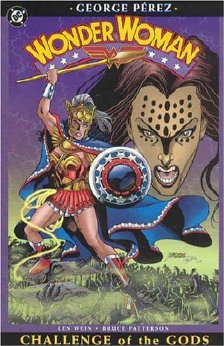
Wonder Woman vol 2: Challenge of the Gods
As with volume one, the friendships are strong, and The individual challenges and battles are entertaining enough, but once again the Amazons are threatened with destruction if Wonder Woman doesn't prove her worth. For a group of immortal warriors, they're awfully vulnerable. Oh, and once again they are threatened with rape. The bulk of the story is shaped by Zeus planning on an extended vacation down on the island full of beautiful women; he's angry when Diana refuses his initial offer of "blessing" and presents her with a series of challenges to prove her worth and preserve her, and the island's, safety from his lust. This is not out of character for the god, really, but this is the second book in a row where rape has been a major plot point.

Also, the whole Hercules raped the Amazons story is continued. While I am quite sure that there are valuable tales to be told about a woman forgiving her rapist, and I'm sure that they could (perhaps have) been told in comic book form, I am also certain that these stories shouldn't involve magically resolving the issue by tying rapist and victim together with a magic lasso of truth. That whole "magical insight" and "instant understanding" completely undermines and ignores the trauma of rape. Having Hercules declared more of a man because he realizes women can be equal to men? Not bad. Rewarding him with a kiss from his victim? Very bad.

Again, there are some good bits here: The friendships remain strong. I liked the Etta and Steve romance--I'm a sucker for a good romance. Also, though I probably wasn't supposed to, I loved the rapacious, over-the-top publicity agent, Myndi Mayer. Here jeweled heels and refusal to take no for an answer were wonderful.

All in all, though, I wouldn't say this was one of my more enjoyable forays into the world of superheroes.

The bit that interests me most is almost a throwaway bit: The first arc in here concerns the Cheetah and her attempt to lure Wonder Woman in by promising her evidence of the lost Amazons, the ones who didn't take the gods offer/exile of life in isolation on Themyscira. Nothing, other than a fight scene, comes of it, but I can't help thinking that there's more to tell of that tale in the future.

So, it's a mixed bag, and of course Perez's reinvention has now been trumped, or at least enfolded, by Straczynski's which has in turn been wiped from continuity by the New 52.

Other Reviews links of interest

Gods and Mortals on Goodreads
Challenge of the Gods on Goodreads

Got a review you think I should link to? Let me know!

Gods and Mortals on Amazon
Challenge of the Gods on Amazon

Monday, November 18, 2013

Book Review: Star Trek: The Next Generation/Doctor Who Assimilation2 Vol. 1

Star Trek: The Next Geneartion/Doctor Who Assimilation2 Vol. 1 is a crossover created by people who clearly love both Star Trek and Doctor Who. Scott Tipton, David Tipton, and Tony Lee catch everyone's voices; I could hear the characters speaking as Doctor McCoy grumbled, the Eleventh Doctor rattled through his speeches, Geordi commented on the technology, Guinan mused on the nature of time—all through the piece, through two Enterprises and two Doctors the pacing and word choice were right on track. J. K. Woodward's catches everyone, down to Riker's signature smirk(1).

Star Trek and Doctor Who are ripe for crossover work. Both feature explorers in space, and often time (there are always anomalies. Then, too, there is the undoubted(2) similarity between the Borg and the Cybermen. The two would think it was a good idea to put their cybernetic minds together to conquer the universe if they ever learned of each other. So, of course, in Assimilation2, they do, and the Eleventh Doctor, Amy, Rory, and the crew of the Enterprise D have to work together to stop them, with a small detour to the past to see a time when the original Enterprise crew stopped a cyber-invasion with the help of the Fourth Doctor. This last puzzles the Doctor as, up until Geordi found the record in the ship's database, he didn't remember the event, and then he did: Time is changing, as Guinan confirms when the two meet. Guinan, by the way, puzzles the Doctor every bit as much as she should. It is a delightful conversation.

Other favorite moments of mine include Rory getting to use his Roman centurion skills while driving a chariot early in the book and the Doctor's delight in meeting Data for the first time. Here, he rattles on in characteristic fascinated-Doctor fashion until Amy reminds him he's being rude.

Woodward uses a painterly style in his art, providing small portraits of the familiar figures of all the crews. He's clearly spent some time looking at their varied expressions and gestures, so it is easy to transition from the television world to the comic book world. It's interesting that he chooses to use something of a 1960's comic book art style when he goes back to portray the first Enterprise's logs.

This is volume one of two, so of course it ends with a cliffhanger. I have volume 2 on hold at the library—so do a few other people. On the one hand, I always love it when other people use the library, on the other, I now have to wait to find out what happens next!
__
(1) Nothing against the character (not most of the time, anyway), but he does smirk.
(2) And probably not coincidental. I can't track down the interview(s) at the moment, but it's pretty clearly on record that the Borg were inspired by early Cybermen. I, for one, jumped up and down in great excitement and rewound multiple times to watch the Cybermen declare "To struggle is futile" in Tomb of the Cybermen when I watched it.

Hmm… I took the time to do a short search, and now I can only find people denying the similarity, which is weird. I thought it was known? And why would it be a problem to design one really creepy set of monsters that are rather like another? I thought it was homage (which is good) not mere copying (which is bad). Ok…that could be a real rabbit trail. Stopping now!

Who's Who
Writers: Scott Tipton, David Tipton, Tony Lee
Art: J. K. Woodward
Additional Art: The Sharp Bros. (Issue #3) and Gordon Purcell (Issue #4)
Cover: J. K. Woodward

Publication Details
Publisher: IDW Publishing
Published: October 9th 2012
ISBN 1613774036 (ISBN13: 9781613774038)

Other Reviews
At Home with Books

Did you write a review? Let me know in the comments or by using the Contact Me link up top, and I'll add a link!

Monday, October 28, 2013

Book Review: Fairest Vol. 2 The Hidden Kingdom by Bill Willingham (author), Lauren Beukes (Author), and Inaki Miranda (Illustrations)

Fairest: The Hidden Kingdom wasn't for me. I can't really say it was a bad book. I think, probably, for what it was, it was a good book, but despite wildly loving the Fables series and thoroughly enjoying Fairest Vol. 1, I found this not my cup of tea. There will be some spoilers in the following, though I will try not to touch on major plot and turning points.

Fairest: The Hidden Kingdom is Rapunzel's story which, like most Fables tales draws from and exaggerates elements of the traditional tales. It seems that, after being kicked out of the tower by the witch, who was none other than Frau Tottenkinder, Rapunzel gave birth to twins with the help of a kindly elderly woman who told her they were stillborn and took the bodies away. She is sure they are alive and that the woman was Frau Tottenkinder, and she spend years looking for them, eventually ending up in the Hidden Kingdom (the Fables version of Japan) shortly before the Adversary invaded.

Now, in present day Fabletown, she is attacked by a flurry of origami cranes with the words "your children" on them. She immediately bargains for help with hair control and heads out to modern Japan in search of the twins. She takes her friend and barber, Joel, with her. She also takes Jack who proceeds to be his egotistical, oversexed, unreliable self through the rest of the book. Yes, I know he's a trickster and that's what tricksters do and are; that doesn't mean I have to like this particular incarnation of the Trickster type.

in any case, the story switches between the three time periods: Rapunzel's life just after being kicked out of her tower, her life in the Hidden Kingdom, and her present-day hunt for her children and attempts to navigate alliances old and new alliances in the unstable Fabletown communities of Japan.

It's not so much that Fairest breaks the Fables mold as that it takes it and pushes its darker side, hard. There's dark and then there's "Dropped down a well and trapped under a pile of your friends' corpses as they decay." There's "weird and a little twisted" and there's "eating your own hair to survive and then coughing up deadly, angry bezoars who devour everyone around." The humor that marked the other tales was largely absent as was most of the warmth.

Too, I found neither love story present particularly compelling. Snow and Bigby have me on their side all the way. Ali and the Snow Queen had me laughing and hoping. Rapunzel and the kitsune? Not so much. As a sexual indulgence I could more or less believe it, as a love that lasts through the centuries and survives multiple perceived and actual betrayals? No. By the end of the story, I did not particularly care for either partner, and was definitely rooting for Puntz to put the past behind her. The other story should have been more compelling; Joel actually is likable, but the ultimate pairing didn't really have the kind of emotional resonance I want.

The art, also, seemed to be more of more: More crowds, more creatures, more scenes, more sex, more fighting. Like the story, it wasn't bad precisely, it just wasn't to my taste.

Read it? What did you think? Got a review I should link to? Let me know, here in the comments or by clicking the "Contact Me" link up there.

Other Reviews
On Fyrefly's Book Blog

Wednesday, October 23, 2013

Book Review: Courtney Crumrin Vols. 1-3 by Ted Naifeh

The Courtney Crumrin books were one of this year's serendipitous finds. I stopped by the library one day and, scanning the shelves, saw a handsome dark blue hardcover book of just the right size to slip into a bag or prop up at the table. Of course, I checked it out and found myself in the world of Courtney, a young teen forced to move from her inner city house to a grand house in a wealthy neighborhood owned by her aloof and somewhat scary Uncle Aloysius Crumrin. This uncle, it turns out, has a library full of books on magic. This comes in handy when Courtney finds that the neighborhood woods is full of goblins and is near the entrance to Goblin Town, a dangerous place for mortals.

Being independent and inquisitive, Courtney soon figures out how to use the spells, and quickly starts exploring the goblin haunted woods, eventually venturing into the Twilight Kingdom where the Faerie folk live. She also experiments a bit with using them to help out in daily life, with somewhat mixed results.

I liked Courtney precisely because she is prickly and aloof or, as she says, "I'm rude, bad-tempered, and basically, I don't like people." She is uncertain and vulnerable in both worlds, and determined to protect herself. Her parents are would-be social climbers who pay more attention to the daughter they want to have than the daughter they do, and Courtney's background makes her unable to reach out to her wealthy and snobbish classmates. She alternates between not caring and wondering what is wrong with her. She's also never quite willing to give up her independence in order to fit in, but she does, gradually begin to trust some of those around her and to gain their trust in return.

I appreciate Naifeh's portrayal of someone who is gifted at magic but also still a young teen. Courtney does some powerful magic, but she also makes some big mistakes as she's learning, and they cost. Neither the human world nor the Faerie world is particularly forgiving, though the Faerie rules are, perhaps, easier to understand in the end.

Naifeh's angular artwork is very well suited to the Fairie folk and their town. The black and white is minimalistic and understated. I admire the line work. In the hardcover versions, color has been added to add atmosphere and lighting more than for detail purposes. The effectiveness of the addition varies: On the one hand, color! On the other, I really liked the understated black and white and don't find that the color always adds as much to the new versions as it could.

By the way, anyone who pays attention to the cover colors will notice that I picked up the third book first. It read quite well as a stand-alone. I went back and read it in its proper order after getting books one and two out, but if you'd rather start later in the series--or can only start later--things should work well!

I find myself in a bit of a bind in terms of copies. I now own two of them in paperback and I like the cleanness of the black and white and the line work. I also like the size: They're small, easy to carry, and light. However, Oni is reissuing the books in hardcover, and, as I mentioned earlier, the books are beautiful with jewel-toned covers, ribbon book marks, and color. They're a nice size, too, not the huge spread of the usual hardcover graphic novel but a nice, well-balanced book that sits nicely in the hand(1). Do I go for a matched set or try for mixed? Neither bookshelf nor wallet supports multiple copies, so no answers of "both" please!

And, for your enjoyment and enlightenment: Here is a spread, both colored and uncolored. My thanks to Oni Press for the use of it!


I have not read Courtney Crumrin and the Monstrous Holiday yet, but the hardcover just came out this month.

--
(1) My library system is awesome; they have both versions of volumes 1-3, and I was able to compare them side by side!
(2) Many thanks to Oni for sending me good-quality versions of the same page in color and in black and white. This way, you can compare!

Monday, October 7, 2013

Book Review: Fairest. Vol. 1 Wide Awake by Bill Willingham (Author) and Phil Jimenez (Illustrator)

Yes, I'm in love with this series!

Fairest: Wide Awake is another spinoff from the main series, but it's by Willingham himself, so it has the balance of fun and seriousness that the tale does so well, plus a good stiff dose of the multi-layered fairytale play: Ali Baba, the Snow Queen, and Sleeping Beauty are main players, and then there's a bottle imp.

It's a spinoff, but it is more closely tied to the main stories than some. I really, really, really don't recommend reading it until you're at least past Volume 16 of the main series, not if you don't want some more spoilers. In fact, if you haven't gotten that far and you do mind spoilers, you should probably just accept that Fairest Vol. 1 is awesome and skip the rest of the review, because there are going to be a couple of spoilers for Fables.

What's Fairest about?

It goes back to battle tactics in Fables. Remember how Sleeping Beauty's curse put everyone around her to sleep? The Fables used this against their enemy, taking her to a major city and having her prick her finger. She thus put an entire enemy city to sleep and was left there to keep them from waking. Later, soldiers were instructed to move and guard her carefully. The problem? There were two beautiful maidens found asleep in the city. Both were collected and left in the center of a camp. Now, a resourceful thief, Ali Baba, has found a bottle imp who leads him to the princesses. He wakes both. One is Sleeping Beauty, one is not. There could be true love ahead. There could be death.

The bottle imp really steals the show here. Oh, the thief and princesses are great, but the bottle imp is the one using his wits and words to shape the tale and he's fantastic. I love the fact that he really wants to be mischievous and cause trouble, but his orders mean he can't--at least, not mostly. This is also the first retelling of "The Snow Queen" I've ever liked.

Also, there is a really heart-breaking "Beauty and the Beast" story at the end. The volume would be worth it just for that.

I don't really recommend this for people who haven't been reading the main series; it will make you want to read the rest, and you'll go into the book with some major plot elements spoiled, but if you like the series, but are unsure about spinoffs, don't wait any longer. Pick it up!

Other Reviews
The Adventures of Cecelia Bedelia
Book Banter
Fyrefly's Book Blog

Links of Interest
Fairest: Wide Awake on Amazon.
Bill Willihngham's website
@BillWillingham on Twitter
Phil Jimenez website

Thursday, October 3, 2013

Book Review: Avengers Arena vol. 1 Kill or Die by Dennis Hopeless(author) and Kev Walker (Illustrator) and Alessandro Vitti (Illustrator)

I picked this up because I wanted to find out what happened to Cammi post-Guardians of the Galaxy, which I loved and am rereading, not because I liked the premise, so you're fairly warned: Kill-or-be-killed is not my preferred genre, and Avengers Arena(1) only reinforced my non-preference.

I still don't really know about Cammi(2). She gets to show up at the beginning, right before she and a lot of other teens, some of whom I recognized, some of whom I did not, are captured by some bored villain to and stashed, his own private little cut-off pocket of space wherein he can manipulate stuff so they have to kill one another in order to amuse and entertain him. Hasn't this guy heard of TV?

In any event, he isn't much amused as the teens spend most of their time wandering around trying to figure out if there's a way off. (There isn't, yet, or we wouldn't have volume 2. I hadn't realized when I checked this out that there was a whole series planned(3)) and vaguely discussing how not to kill anyone, while someone or another is staging sneak attacks. I think one or two characters might actually have died in the attacks, but not only is this hard to be sure of for comic book reasons (people turn out not to be dead all of the time for various good and bad reasons), it's hard to keep track because I only recognize a few of the characters and only really know a couple, so it's hard to keep them straight. This combination drastically undercuts the "suspense": It's hard to care who's doing what to whom if you don't know why they are in the first place, and harder still of a drowned team mate isn't actually dead after all.

Mostly, everyone persists in wandering around talking and not fighting. This is an odd thing for me to complain about, since I don't actually want them to fight; I haven't even read Hunger Games, for crying out loud, and that's supposed to be really good. I just want them to do something, to have some sort of a story, and they don't--there's no option but to kill, and little desire to kill, so the plot options are severely limited.

There's not even much by way of character development, the sort of thing desert island scenarios are built for. Oh, they talk, and someone everyone thought was nice turns out to be a nasty, manipulative sort, but I didn't know her enough before to find this surprising, or even to know if I was meant to find it surprising, or how surprising anyone else on her "team" finds it, or even to remember her name, so it's a wash in terms of development or caring.

Not even the guy who assembled the bunch appears to have thought things through much. Arcade's teenage "contestants" include Cammi, who is entirely normal human in terms of strength, Darkhawk, who isn't actually a teen, and a cyborg girl, who has had no training at all--she's barely had time to realize she has implants. You'd think if the guy wanted excitement he'd have gone for the more explosive and trained sorts.

By the end of this volume Arcade, like the reader, decides not enough is happening. Rather than taking this as a cue to abort the experiment and take up crocheting or chess, he opts to up the stakes a bit by making survival-without-killing even harder. The abductees still stubbornly refuse to go Lord of the Flies, though there are ominous hints that Things are Only Going to Get Worse.

I'm not holding my breath.

---
(1) Named that because a small segment of the stolen teens are Avengers in training. Why their teachers haven't found them yet, I don't know.
(2) Except that she's doomed. She may have good survival skills, but they're the sort that mean forming strategic alliances and knowing when to run. There is no way for her to be the last one standing in a pure power fight. So, yeah. She's doomed, and Drax (if Bendis remembers to have him remember her) will have something more to angst about. Basically, Murder World is a giant refrigerator. No one is going to get a heroic death; the survivor(s) will get to mourn, and that will be that. Unless, that is, someone hits the reset button.

(3) It would work better as a six-issue miniseries, I think. That would actually open the door for more options: They could overcome Arcade, outwait Arcade, actually act like heroes....

Relevant Details
Paperback, 144 pages
Published May 21st 2013 by Marvel
ISBN 0785166572 (ISBN13: 9780785166573)

Author: Dennis Hopeless
Illustrations: Kev Walker & Alessandro Vitti

Links of Interest
Avengers Arena on Goodreads

Know of a review I should include? A link I should add? Drop me a line and let me know!

Thursday, September 26, 2013

Book Review: Cinderella vol. 2 Fables are Forever by Chris Roberson (Author) and Shawn McManus (Illustrator)

Oh dear.

As I may have mentioned once or twice, I absolutely love the main Fables series, so of course I'm running out to pick up all the other books around it. Fables are Forever is something of a disappointment, even though it works with spy-Cinderella, whom I love, and has fun with genres and characters, which I also love.

Cinderella has to face off with "the Silver Slipper," an assassin foe from her past. Having this super-assassin turn out to be Dorothy Gale was clever, but other than that, there's really not much substance to the book. Dorothy and Cinderella try to kill each other several times over the years and in many different countries. There's no character development for either, and thus no real reason to like or dislike Cinderella any more than I already did. Dorothy is so one-dimensional that her evilness is more a matter of form than anything else.

There's some shallow discussion of the difference between a mercenary and a patriot, and who is more justified in which despicable actions, but it doesn't really go anywhere. It's not a case of either woman developing doubts, or of letting the reader explore the issue, it's just what a pair of spies chat about while they fight.

The art was...eh. I mean, it's not entirely out of character for Cindy to traipse around in the snow in a bikini, but surely even Fables get cold? Shouldn't she be blue and shivering, not svelte and appealing?

So, overall, this was a disappointment. I mean, it's not that it's especially ghastly, it just has a really, really high bar to reach, and it settles for being decidedly average.

Other Reviews
Back to Books
Comic Book Resources
Got a review I missed? Drop me a line and I'll include it!

Links of Interest
Chris Roberson's home page.

Monday, September 23, 2013

Book Review: Cinderella Vol. 1 From Fabletown with Love by Chris Roberson (Author) and Shawn McManus (Illustrator)

Yes, I read the Cinderella books out of order. This was sloppy of me, but I'm glad I did it.

Fables Are Forever had me just about give up on the Fables spinoffs. From Fabletown with Love has restored my faith.

For one thing, there is a lot more going on here. The Fables all work very hard at keeping their true nature hidden from the mundane world. Now, someone is selling magic items wholesale, and Cinderella has to figure out who it is and stop them before the world wakes up to the existence of real, and powerful, magic. She also has to deal with witches, a fairy godmother, and a handsome stranger who may or may not be on her side. In the meantime, her shoe-shop in Fabletown is being run by a disgruntled employee who wants to make changes of his own.

There are no deep character insights; perhaps Roberson is being kept on a leash in terms of development, but there's a bit from Cinderella's past, some amusing work with her assistant and his Fabletown problems, and enough variety of setting and plot to keep things fun.

It's not quite the heady amazing awesomeness of the main storyline, but it's good, and it's got the same sense of play that underlies them, the sense that the entire world is a treasure box of stories just waiting to be pulled out and played with.

Oh, and it takes place late in the series. If you mind spoilers, don't read it until you're through Fables: The Dark Ages vol. 12 of the main Fables arc. As best I can tell by the dates, you should be safe at that point. If anyone wants to give me a better estimate, send me an email. I really did tumble through the main series in record time, not keeping track of what went where, just so I could findoutwhathappensnext. This makes me enthusiastic, but not terribly helpful about specific volumes.

Other Reviews
Fantasy & SciFi Lovin' Reviews
Get Graphic
Fyrefly's Book Blog

Links of Interest
Chris Roberson's home page
Shawn McManus's home page.

Got a link or review I missed and should include? Let me know and I'll add it to the list!

Book Review: Final Crisis by Grant Morrison, J.G. Jones (Illustrator), Doug Mahnke (Illustrator), Jay Babcock (Introduction)

This is not really a review, more a puzzled musing.

I'm not having any luck with JLA comics. So far, every single TPB I've picked up has featured not only the entire massive team but also all their alternates from every possible universe.

This one is no exception: Final Crisis, has more than the JLA (My brother read this over my shoulder and repeatedly reminded me, "It's not a JLA comic; it's a crisis crossover." I agreed to pass that news on, for whatever it's worth).

What is the story? Well, um--Darkseid decides to take over the multiverse with a form of "anti-life" that basically makes everyone him. There are Monitors trying to take care of the "purity" of everything, a cosmic vampire-thing trying to eat all life, and a whole lot of superheroes of all sorts. There's an unnumbered quantity of "ultimate" this and thats running around. Various boundaries get broken, assorted family members and loads of characters I didn't recognize show up. People get killed. Things happen.

I enjoyed it, in a way, just letting the story happen and surfing along through the madness, but it's certainly no story for beginners!

No other JLA I've picked up has been as interesting, or as puzzling, but they've all packed in just about every possible character possible and then some, usually without any sort of intro, and generally including alter-egos, family members, and alternates.

So, gentle readers, should I ever get my act together and decide to approach the Justice League in an organized fashion rather than going by title, author, or book-on-the-shelf, what should I pick? Which books actually attempt to stick to a somewhat manageable team level? Bonus points if they actually introduce the character somewhere before the story starts.

Other (more reviewy) reviews
Fifty Books Project
Huh. Fifty Books was all the book blog search engine turned up. Got one I should add to the list? If so, let me know!

Monday, September 16, 2013

Book Review: Uncanny X-men : The Complete Collection. Volume 3 by Matt Fraction (writer), Kieron Gillen (writer), Greg Land (art), Whilce Portacio (art), Phil Jimenez (art), Steve Sanders (art), Jamie McKelvie(art)

On reading this, I found out it took place just before Avengers vs. X-men. I'd probably have read it first if I'd known. I do wish Marvel and DC would think to include chronological lists of the recent publications inside each volume--they do on some, but not on others.

There's going to be a middling spoiler in here; I'll post a warning, but if you're like me, you're past warnings almost before you see them, so here's a heads-up.

There are two major plots in this one: Hope, the "mutant messiah" is settling in on Utopia and is asked to help a handful of emerging mutants figure out how to cope with their new powers. Meanwhile, an entrepreneur is to copy & sell mutant powers, but on the side, he's trying to blackmail the X-men into selling the right to copyright their genome in return for curing them of a plague. Oh and Emma has to deal with Shaw once and for all (or until the next writer gets bored). Also, the mutants finally get around to hiring a PR specialist. It's only taken them--how long?

Two of the plots--Hope's miraculous ability to help new mutants figure out their power and the confrontation between Emma and Shaw were fairly standard stuff. In fact, the Hope line annoyed me a bit because it threw in the tiresome "God won't help you" line that various writers keep shoving into the different X-books (or at least the ones I'm reading lately). On the plus side, there, though, at least one of the emerging mutants had parents who were concerned about him and just wanted someone to help their son. After reading so many "turn mutant and everyone hates you" books, it's nice to see that someone realizes this isn't a universal truth.

The more interesting line was the mutant powers as drug line.

Spoiler starts here:


I loved the idea of mutant power being cool. Who wouldn't want to fly? If you could buy wings for, say, a day or a week, wouldn't you? What would that do to the mutants if their power could be easily copied and spread? If they were trademarked rather than evil? How would that change their view of themselves? Their view of the world? The world's view of them?

I really wish this had been a longer-running story with more twists and turns to it, with all the mutants having a say in what happened and maybe even considering the offer. Instead, of course, the corporation turns out to be standard-issue Evil, making the drug addictive and customizing a plague to kill the mutants if they don't cooperate. It's all over fairly quickly, all things considered.


Spoiler ends here.

However, the plot was left somewhat open-ended, and overall, the book was a reminder of why I spent a few years reading the X-men obsessively, and they were my gateway to superhero comics and, ultimately, through a long, slow road to comics in general. I also appreciated the publicist. Finally, the X-Men are thinking about how to manage their image, and paying someone who does her job and does it well and to the best of her ability. I wonder where, when, and why she disappeared?

Also, this collection made sense: All the relevant bits to each story were included. That may sound like faint praise, but I'm slowly learning that this is not always the case.

So, overall: Not a book that will addict you to the X-men or to comic books if you aren't already a reader, but an entertaining way to spend the time if you are.

Reviews
Uncanny X-Men: The Complete Collection on Goodreads.
Anyone got links to others? I kept finding bits and pieces, but not the whole. I admit, I didn't search very far, so if you wrote one, send me the link and I'll put it up!

Mervi's Book Reviews has a reviewof Quarantine, one of the tales in this collection.

Links of Interest
Whilce Portacio on Facebook. He tends to show work-in-progress and talk about how and why he makes decisions. Definitely worth following!

Uncanny X-Men: The Complete Collection
Volume 3 on Amazon.

Monday, September 9, 2013

Book Review: All-new X-Men. Vol. 1, Yesterday's X-Men by by Brian Michael Bendis (Author), and Stuart Immonen (Illustrations)

During Avengers vs. X-Men,Cyclops, leader of various teams of the X-Men for, oh, forever, possessed/was possessed by the Phoenix force. He went from slightly obsessed with preserving the remaining mutants to flat-out crazy dark in no time flat. After the Phoenix force was dealt with, he was briefly penitent, but because the world hates-and-fears mutants, he was pushed back into darkness in record time.

Now he's teamed up with Magneto, who is back to being evil again, and is declaring a mutant revolution. In order to stop him, Beast imports the past X-Men with the idea that the young, idealistic Scott will be able stop cynical, evil Scott, or at least make him feel good and guilty.

It's an interesting idea, but there's not much room for it to grow here. Yesterday's X-Men is very much a stage-setting volume and what comes after might or might not develop into something character-driven and fun, but for the moment, I'm left wondering. I have liked X-Men stories in the past--devoured them in fact--but I'm starting to wonder if the series and I are going to get along very well this time around. Maybe I should go back to the independents again.

As with the whole Avengers vs. X-Men series (or at least, all I've read of it; there seem to be an uncountable number of side books) a good many things happen "because plot." I know the "hates and fears" thing is part of the whole X-Men schtick and has been from the beginning, but there's very little refinement here. Three different teens, two with completely non-scary power manifestations (one is a healer), are surrounded by the authorities the moment their powers show. Their parents disown them. Their friends don't like them any more. Really? Come on. I know people are weird, scary, and unpredictable. They're also disorganized, prone to letting things go, and actually capable of loving their children, friends, and relations. It's been years since "the mutant gene" first manifested, and I have a hard time thinking that most of the world still panics at the thought of non-explody mutants. See what I mean about me and the series?

Also, I have to take a moment to whine about Cyclops: I rather liked the idealistic version, and I've been frustrated by various writers working over the years to make him more interesting, usually by adding a lot of angst and anger to his character and subtracting any and all thought and planning from his skill set.

As I mentioned earlier, the bulk of this volume is spent setting the scene and bringing the old team forward. There's not much time for present X-men to interact with their past selves, or for the past selves to see the world and try to cope with how it has changed and how they--their future selves--have responded. It'll be interesting to see how that develops, and whether the various writers can handle the oversized team(s?) that will result.

Until next time!

Links:
Yesterday's X-Men on Goodreads
Yesterday's X-Men on Amazon

Did you write a review I should add? Know of one? If so, contact me and let me know!

Monday, September 2, 2013

Book Review: Fables: Werewoles of the Heartlands by Bill Wilingham (Author), Craig Hamilton (Illustrator), Jim Fern (Illustrator)

This is outside of the Fables main plot, for the most part, and I'm glad this is far from the first Fables book I picked up. I love the series in general (see the understatement there? See?) but this one--eh.

Bigby is looking for a new home for the Fables, traveling through the Midwest. Along the way, he stops at a town full of werewolves, and they both want to worship him and to kill him. There's a certain amount of backstory here and hints that it will tie into the main story later, but on its own, it's a fairly generic fight story. Honestly, it reminded me of Wolverine in his more incomprehensible honorable modes than anything else, and Bigby usually doesn't (No dead girlfriends, for one thing). It's just lots of fighting and "you're not worthy to be a wolf"-ing, and some explosions, and the undoing of a rather good short story included elsewhere.

There's some plotting and counter-plotting going on in the town itself, but all the fighting ends up rendering everyone's plans moot, and I knew too little about any of the characters to really care which side came out on top anyway.

This is a shame because under ordinary circumstances Bigby is one of my favorite characters, and I was super-excited about the book that featured him. I was hoping for more detective work, as in Legends in Exile, or more of his history, perhaps.

Willinham does include an essay about his real visit to the real Story City at the end, and I enjoyed that. Verdict? Check this one out from the library, read the essay, and politely return the book. Then read, or reread, the Fables proper.

Other Reviews
Fyrefly's Book Blog
Other Reviews found through the book blog search engine
Did I miss a link I should include? Let me know and I'll add it!

Links of Interest
Bill Willihngham's website
@BillWillingham on Twitter.


Wednesday, August 21, 2013

Book Review Fables: The Great Fables Crossover by by Bill Willingham (Author), Matthew Sturges (Author), Russ Braun (Illustrator), José Marzán Jr. (Illustrator), Mark Buckingham (Illustrator), Andrew Pepoy (Illustrator)

The Great Fables Crossover is getting its own min-review because it's something of an oddity. I loved Fables, and I was devouring them as quickly as I could, but then I hit volume 13 and was thrown back.

You see, it mostly departs from an ongoing, rather urgent arc in Fables, to tell its own story. It's clear from bits and pieces here and there that the big tale is still continuing, but now there's another danger: Someone is trying to rewrite the world and in this case, that is entirely literal. If Kevin Thorne gets over his writer's block and decides what revisions he wants to make, the world we know will become an entirely different place. Jack discovers the danger and comes back to warn the Fables who set out to stop him, despite the way Thorne keeps writing difficulties for them.

This is a crossover with Jack of Fables, which I have yet to read. In many ways, I think it's more of a Jack story than a Fables tale. The good news is, I enjoyed the humor in the Jack of Fables Books. There is a visit by all of the genres incarnated as characters to offer the would-be reviser advice, and they're great. Fantasy, especially, is a wispy, elvish sort who keeps wanting everything turned into an epic while science fiction proposes manly battles. So: I will have a new series to follow, and that is good.

The bad news: The Great Fables Crossover comes smack in the middle of the battle with the Dark One and diverts everything onto a completely different path. I read it while saying "But what's happening with the Dark One? What are they going to do?" and the like. I suspect that for me, and for any beginning Fables reader, it will be better on the second read, and maybe after I've read the Jack of Fables series and learned more about the Literals.

Really, if you're plowing through the books for the first time, you may want to set this aside to read while you're waiting for Fables 19 to come out.

It does get bonus points, though, for having a fantastic fighter whose place of power is the library. YES!

My review of the Fables series as a whole is here.

Reviews
Fyrefly Books
BookBanter
Back to Books

Got a review I should include? Drop me a line and let me know!

Links of Interest

The Great Fables Crossover on Amazon.

Monday, August 19, 2013

Book Review: Fables by Bill Willingham


First, a confession: I lied up there in the title.

This is not a review. It's a rave, or perhaps a gush.

I fell head over heals in love with the series with volume one, Legends in Exile and proceeded to scramble through the books as fast as I could get my hands on them, with no pauses for rational thought, review, or evaluation(1).

I'm not being even remotely, slightly, or at all objective when I tell you: Don't make my mistake and leave these on the shelves for a rainy day sometime. Read them.

Read them all.

Now.

Oh, and try to make sure you have at least the first few volumes on hand when you start, so you don't have to wait between books, ok?

The basic premise is that the Fables, characters familiar to us from fairy tales, legends, myths, and novels from around the world, have had to flee their various worlds. Their foe, known for several books only as the Adversary, has driven them out, leaving only a small refuge in ours. As a result, characters who normally would be enemies or have nothing to do with one another, have had to find a way to live with one another in our world, and to hide themselves from us: Whatever they look like, they are all immortal (but not invulnerable) and often magical, and they can't risk us ordinary mortals, or mundanes, discovering them. They also want their Homeland(s) back, somehow, some day, and there are a number of magical threats other than the Adversary to trouble them.

I took a few notes on Legends in Exile, which is noir, fairy tale, and fantasy all mixed together. Rose Red, Snow White's sister, has been murdered, and the sheriff, the Big Bad Wolf, has to find the killer. Willingham knows how to use the various tropes he calls on well and has made the modern-day embodiments of famous fairy tale characters into strong characters I can root for. It's a fantastic mystery with unexpected turns, plenty of humor, some darkness, and a great resolution. It's also a fantastic opening for a series that never after that sticks to a single genre.


Different Fables volumes tackle, legend, fairy tale, spy story. They tell tales of survival, of revenge, of new beginnings, of unexpected endings, of triumphant love, and failed love, and friendship, loyalty, and betrayal, and pardon. Fair warning: They can be sweet, and they are often funny, but they can also be sad. While he doesn't have George R. R. Martin's legendary bloodthirstiness, Willingham is quite ruthless about character deaths. There are some real blows in the series.

As far as I can tell, each volume accomplishes that difficult feat of being readable as a stand-alone (I confess, I actually read volume 8, Wolves first) and as part of an arc. And then, the overall story accomplishes an even more difficult feat: It finishes out one arc and starts another while still going strong, and then moves forward to still another, without forgetting the consequences of prior acts. Am I addicted? Oh yes, I'm hopelessly, haplessly, and wonderfully addicted.

Part of the fun is the way Willingham plays with the details: The Beast's curse, for example, waxes and wanes for much of the series. If he and Beauty are having a good day, he's a handsome prince. If they're arguing, he gets more beastly looking. The Big Bad Wolf is the wolf of Red Riding Hood fame. He's also the wolf who huffed and puffed and blew the little pigs' house down, and how and why he came by that power is another tale entirely, one told through several different volumes.

I can't gush enough about the series' general awesomeness. My only real complaint is that now I'll have to wait until volume 19, and then probably through 20. Oh well. I guess I can reread them in the meantime, perhaps a little more slowly so as to savor them (Who am I kidding? It'll be at least a couple more reads before "slow" even starts to be an option).

--
(1)Ok, one pause. The Great Fables Crossover is getting its own, separate review later this week; it's a crossover and that makes it--odd.

Reviews
Fyrefly reviewed them properly, one at a time.
If you have written one or know one I should include, let me know and I will add the link.

Links of Interest
Bill Willihngham's website
@BillWillingham on Twitter.

The Books on Amazon--which also gives you a list of the volumes in order
That said: Visit your local library! Seriously. Libraries are awesome.

Fables: Legends in Exile
Fables: Animal Farm
Fables: Storybook Love
Fables: March of the Wooden Soldiers
Fables: The Mean Seasons
Fables: Homelands
Fables: Arabian Nights (and Days)
Fables: Wolves
Sons of Empire
Fables: The Good Prince
Fables: War and Pieces
Fables: The Dark Ages
The Great Fables Crossover
Fables: Witches
Fables: Rose Red
Fables: Super Team
Fables: Inherit the Wind
Cubs in Toyland
Fables 19 coming out in December 2013


Monday, August 12, 2013

Book Review: The Dark Crystal : Creation Myths Vols. 1 & 2 by Joshua Dysart (writer), Alex Sheikman (Illustrator), Lizzy John (Illustrator) and Brian Fround (Illustrator)

Creation Myths are, as one might suspect, the prequel to the movie The Dark Crystal. I was skeptical about the idea at first: I'm not terribly fond of tie-ins as a general rule, but it turns out that these fit the movie very well, both in tone and content. The world is created, a great mother watches over everyone, and then outsiders come and are welcomed. Do they deserve the welcome? Or does the suspicion of one person doom them? How did the Crystal come to break? And how did the Skeksis and Mystics get separated in the first place? Creation Myths gives the backstory to the movie, and they fit the tone, mood, and look very well.

There were were a couple of points I thought the myth lapsed; early Thra appears to have been a near-paradise, but there are also hero tales of people freeing others from evil dictators, so it clearly wasn't perfect. The distant, mythic feel to everything also means I never truly got attached to any of the individuals, not even the singer, Gyr, who travels through most of the second book, but then, fairy tales as such aren't about getting attached to the individual. They're more about the world they portray, and Creation Myths understands that very well.

The tales are lovely little fairy stories, but the real beauty here is the illustrations. They are lavish, beautiful chances to revisit the splendors of The Dark Crystal world and to see things that the filmmakers couldn't afford to show us, things like Aughra's full orrery. There are villages and seas and strange animals, and it is a wonder to behold.

Recommended for anyone who loved The Dark Crystal or Labyrinth or any of Henson's more mythic work.

Reviews
Creation Myths Vol. 1 on Goodreads
Creation Myths Vol. 2 on Goodreads

Did I miss a review I should include? Drop me a line and let me know!

Links of Interest
Remember when I mentioned I'd started watching publishers? I haven't quite made up my mind yet, but I think Archaia Entertainment is going to turn out to be one of them. They do publish such a variety of interesting stuff, and their books are also beautiful physically. They have lovely, smooth covers and are easy to hold, and great illustrations.

Dark Crystal: Creation Myths vol. 1 on Amazon
Dark Crystal: Creation Myths vol 2 on Amazon