Wednesday, November 30, 2011
More Mysterious Book Sculptures
The Edinburgh book-sculptor strikes again, leaving what she says is the last of ten exquisite book-sculptures in libraries:


Leftover Adventures: Sweet Potatoes
You know how it is. The sweet potatoes, those delicious, golden, delightful treats, have been taken from the Thanksgiving table and are now sitting in your refrigerator, limp, cold, and oozing sticky liquid. What are you going to do with them?
Pies, cakes, and sweet breads are out. It's after Thanksgiving and before Christmas. No one needs more deserts. They don't reheat well, and anyway, everyone is glutted on leftovers, so just re-serving them won't do.
Time to turn to the internet for recipes! And then, if you're like me, to adjust the recipes to suit what is actually in the fridge rather than what else you might add to the bounty.
Last night's main course was Jamaican Red Bean Stew, from the Savvy Vegetarian, which gets bonus points for being a crockpot recipe and additional bonus points for being vegetarian and thus something everyone will eat. Crockpot recipes are good. I can make them when I have the time and other people can eat them when they have the time, and it works out well for everyone.
Variations ensue: I discover that I don't have red beans. The cupboard appears to have every other kind of bean, canned and dried, but not red. So, I cook some pinto beans, which turns out well, but means there's more liquid than the recipe strictly calls for.
Because of that, and because I just don't feel like using them, I leave out the canned tomatoes.
I use the whole can of light coconut milk because a partial can of anything is hard to figure out what to do with. That, also, affects the amount of liquid, but since I'm using bouillon, not broth, it's easy to adjust there.
And I used about 1/8 of a teaspoon red pepper flakes and substitute a yellow onion for scallions. Onion, I always have on hand. Scallions take planning. Besides, the goal is to use what is here, not to add to the collection.
Verdict? Yum! This recipe (alterations and all) is a keeper. It's sweet and creamy with just a hint of a bite from the red pepper flakes and a slight tang from the onion.
On to the side dish:
Sweet Potato Biscuits, from Cooking Light. Alterations: None. Biscuits are picky. Result? A very tasty, golden biscuit. They were slightly tough, which mostly means I handled them too much, but also, given the crunchy bottoms, that I should have baked them for maybe two minutes less.
After dinner, with one-and-a-bit sweet potato left, I decided to make Sweet Potato Yeast Bread, which I made last year. I had to think about this one because I used part of one recipe and part of another and did not make notes. I often forget to make notes when I wander away on my own paths. I know I used one of Cooking Light's recipes to get ideas for the flavoring. I'm pretty sure it was Sweet Potato Bread with Flax Seed, though I left the flax seed out because not everyone likes it. Also, I definitely used less sweet stuff, because this is bread, not cake. Then I put it into yeast bread. This time, I took notes:
Sweet Potato Yeast Bread
1 T sugar
1 T dry yeast
1/4 Cup water
1 1/2 C flour
1 1/2 C whole wheat flour
1 T butter
1 t salt
1/4 C brown sugar
Bake at 375 for 15 minutes and 350 for half an hour. If it sounds sort of hollow when you flick the bottom (Kind of a "thwock" sound), it's done.
The water is going to be really approximate. I thought I'd add 1/4 cup and ended up adding 1/3 because it seemed to dry, and then found I had to add a bit more flour. It might be easier to regulate hand-kneading, but there was a lot else going on, so I let the bread machine take care of that part. The dough was really soft and sticky, even then, so though it worked, I'm back to thinking 1/4 C is a better starting point.
Pies, cakes, and sweet breads are out. It's after Thanksgiving and before Christmas. No one needs more deserts. They don't reheat well, and anyway, everyone is glutted on leftovers, so just re-serving them won't do.
Time to turn to the internet for recipes! And then, if you're like me, to adjust the recipes to suit what is actually in the fridge rather than what else you might add to the bounty.
Last night's main course was Jamaican Red Bean Stew, from the Savvy Vegetarian, which gets bonus points for being a crockpot recipe and additional bonus points for being vegetarian and thus something everyone will eat. Crockpot recipes are good. I can make them when I have the time and other people can eat them when they have the time, and it works out well for everyone.
Variations ensue: I discover that I don't have red beans. The cupboard appears to have every other kind of bean, canned and dried, but not red. So, I cook some pinto beans, which turns out well, but means there's more liquid than the recipe strictly calls for.
Because of that, and because I just don't feel like using them, I leave out the canned tomatoes.
I use the whole can of light coconut milk because a partial can of anything is hard to figure out what to do with. That, also, affects the amount of liquid, but since I'm using bouillon, not broth, it's easy to adjust there.
And I used about 1/8 of a teaspoon red pepper flakes and substitute a yellow onion for scallions. Onion, I always have on hand. Scallions take planning. Besides, the goal is to use what is here, not to add to the collection.
Verdict? Yum! This recipe (alterations and all) is a keeper. It's sweet and creamy with just a hint of a bite from the red pepper flakes and a slight tang from the onion.
On to the side dish:
Sweet Potato Biscuits, from Cooking Light. Alterations: None. Biscuits are picky. Result? A very tasty, golden biscuit. They were slightly tough, which mostly means I handled them too much, but also, given the crunchy bottoms, that I should have baked them for maybe two minutes less.
After dinner, with one-and-a-bit sweet potato left, I decided to make Sweet Potato Yeast Bread, which I made last year. I had to think about this one because I used part of one recipe and part of another and did not make notes. I often forget to make notes when I wander away on my own paths. I know I used one of Cooking Light's recipes to get ideas for the flavoring. I'm pretty sure it was Sweet Potato Bread with Flax Seed, though I left the flax seed out because not everyone likes it. Also, I definitely used less sweet stuff, because this is bread, not cake. Then I put it into yeast bread. This time, I took notes:
Sweet Potato Yeast Bread
1 T sugar
1 T dry yeast
1/4 Cup water
1 1/2 C flour
1 1/2 C whole wheat flour
1 T butter
1 t salt
1/4 C brown sugar
Bake at 375 for 15 minutes and 350 for half an hour. If it sounds sort of hollow when you flick the bottom (Kind of a "thwock" sound), it's done.
The water is going to be really approximate. I thought I'd add 1/4 cup and ended up adding 1/3 because it seemed to dry, and then found I had to add a bit more flour. It might be easier to regulate hand-kneading, but there was a lot else going on, so I let the bread machine take care of that part. The dough was really soft and sticky, even then, so though it worked, I'm back to thinking 1/4 C is a better starting point.
The bread is still good, though, a soft, sweet, golden loaf. It's prone to crumbling, but I don't think it's going to be sitting around very long.
Tuesday, November 29, 2011
Once Upon a Time: That Still Small Voice, a Review
You know, it's harder to review a series I really like than to review one I dislike or just tolerate. I'm thoroughly enjoying Once Upon a Time, with only a couple of very mild protests based on where they might go. The heroes are likeable, the villains properly villainous, the acting is good, the story keeps unrolling and developing interesting new wrinkles, and the creators really are making use of the fairy tales, embroidering and altering the familiar in fun, fascinating ways. What's not to like?
That Still Small Voice gives Jiminy Cricket's past in the fairy tale land.
Meanwhile, in Storybrook, the plot threads are multiplying. A mysterious hole opens up. The mayor wants it closed. Her son wants to it explored. After Regina pushes Archie Hopper to completely destroy Henry's delusion, denying the reality of the tales, he heads down there on his own. Meanwhile, Margaret Mary and John Doe are continuing to spend time together, though his wife/fiancee continually interrupts them. Sheriff Graham officially deputized Emma whose first case turns out to be rescuing Henry and Archie from the sinkhole. We never quite see what is down there, not for sure, but enough is shown to indicate that Henry was right: It should be looked at.
I like the way the two strands, Storybrook and fairy tale are being intertwined. There is usually enough of a tale in the fair-tale side to give a finished story while the Storybrook side moves forward more slowly. Yes, there's always an element of "To be continued..." even in the fairytale side, but still, it's a good balance between the single and the ongoing story, a have your cake and eat it too situation. Also, the two sides usually comment on one another as we see different aspects of the characters and their continuing difficulties. Here we learn more about what kind of person Archie/Jiminy is, and see that he's had a long struggle with the whole matter of conscience.
__
Story-related wonderings:
Does all magic have a cost? Rumplestiltskin is certainly fond of saying so, but he's not precisely a reliable source. The Blue Fairy makes no such demand on Jiminy when she shows up to answer his wish. On the other hand, she turns him into a cricket, which strikes me as doom enough, even if it is what Jiminy wished for (And he can't have been thinking clearly at the time. Crickets are prey to just about every bird, frog, and toad out there, even if they carry really good umbrellas, plus there's the whole "Being a conscience" deal, which sounds decidedly un-fun).
Why are the couple who got turned into dolls in fairy-tale land still dolls in Storybrook? Shouldn't they be, I don't know, paralyzed, or in a coma or something? Does their presence mean Rumplestiltskin/Mr. Gold remembers who he is and where he is from?
Regina looked pretty unhappy about Emma showing up as a deputy. I guess it wasn't on her orders, after all. She does seem to be losing control of the town fairly quickly. Also, she seemed genuinely worried about Henry. Does this mean that one of the shifts Emma's arrival has caused a shift in the Evil Queen as well? Near as I can tell, she gave up the ability to love as part of her price for the curse. Is she getting it back? If so, what will that mean? (It's not like having the ability kept her from killing her father, pre-curse).
If the curse is broken, will everyone want to return to fairytale land? There doesn't seem to be anything fundamentally wrong with Storybrook as a place to live. The problem is the loss of memory and, in many cases, established relationships. As the series shows more of the fairytale land, it also shows that there were plenty of problems there, as well. If it had truly been perfect, Rumplestiltskin would never have been able to sell his curse.
Where did Henry get that story book, anyway? It is not just any old book of fairy tales. The stories in it do not run the way the fairy tales on my bookshelf run. So--who gave it to him? When? Why?
__
The mild caveats: Still the same ones I mentioned back in my review of The Price of Gold. I really don't want the "Who is sleeping with whom?" aspect to eat the show. I'm watching the Mary Margaret/John Doe line with equal amounts if interest and uneasiness. It could work out just fine. It could turn into a tiresome tangle. We shall see. The same goes for the possible triangle with Regina, Emma, and the sheriff (Possible. The show could head in that direction. It could not).
__
Random Thoughts and Observations:
1)Bright green crickets that sing in the rain? Guess that goes along with dark red Honeycrisp apples.
2) My, the blue fairy certainly is busty, isn't she?
3) Who is the sheriff, anyway? In fairytale terms, that is.
As of this writing, That Still Small Voice is up on hulu. There's now a note there saying it will remain up until January 9.
That Still Small Voice gives Jiminy Cricket's past in the fairy tale land.
Meanwhile, in Storybrook, the plot threads are multiplying. A mysterious hole opens up. The mayor wants it closed. Her son wants to it explored. After Regina pushes Archie Hopper to completely destroy Henry's delusion, denying the reality of the tales, he heads down there on his own. Meanwhile, Margaret Mary and John Doe are continuing to spend time together, though his wife/fiancee continually interrupts them. Sheriff Graham officially deputized Emma whose first case turns out to be rescuing Henry and Archie from the sinkhole. We never quite see what is down there, not for sure, but enough is shown to indicate that Henry was right: It should be looked at.
I like the way the two strands, Storybrook and fairy tale are being intertwined. There is usually enough of a tale in the fair-tale side to give a finished story while the Storybrook side moves forward more slowly. Yes, there's always an element of "To be continued..." even in the fairytale side, but still, it's a good balance between the single and the ongoing story, a have your cake and eat it too situation. Also, the two sides usually comment on one another as we see different aspects of the characters and their continuing difficulties. Here we learn more about what kind of person Archie/Jiminy is, and see that he's had a long struggle with the whole matter of conscience.
__
Story-related wonderings:
Does all magic have a cost? Rumplestiltskin is certainly fond of saying so, but he's not precisely a reliable source. The Blue Fairy makes no such demand on Jiminy when she shows up to answer his wish. On the other hand, she turns him into a cricket, which strikes me as doom enough, even if it is what Jiminy wished for (And he can't have been thinking clearly at the time. Crickets are prey to just about every bird, frog, and toad out there, even if they carry really good umbrellas, plus there's the whole "Being a conscience" deal, which sounds decidedly un-fun).
Why are the couple who got turned into dolls in fairy-tale land still dolls in Storybrook? Shouldn't they be, I don't know, paralyzed, or in a coma or something? Does their presence mean Rumplestiltskin/Mr. Gold remembers who he is and where he is from?
Regina looked pretty unhappy about Emma showing up as a deputy. I guess it wasn't on her orders, after all. She does seem to be losing control of the town fairly quickly. Also, she seemed genuinely worried about Henry. Does this mean that one of the shifts Emma's arrival has caused a shift in the Evil Queen as well? Near as I can tell, she gave up the ability to love as part of her price for the curse. Is she getting it back? If so, what will that mean? (It's not like having the ability kept her from killing her father, pre-curse).
If the curse is broken, will everyone want to return to fairytale land? There doesn't seem to be anything fundamentally wrong with Storybrook as a place to live. The problem is the loss of memory and, in many cases, established relationships. As the series shows more of the fairytale land, it also shows that there were plenty of problems there, as well. If it had truly been perfect, Rumplestiltskin would never have been able to sell his curse.
Where did Henry get that story book, anyway? It is not just any old book of fairy tales. The stories in it do not run the way the fairy tales on my bookshelf run. So--who gave it to him? When? Why?
__
The mild caveats: Still the same ones I mentioned back in my review of The Price of Gold. I really don't want the "Who is sleeping with whom?" aspect to eat the show. I'm watching the Mary Margaret/John Doe line with equal amounts if interest and uneasiness. It could work out just fine. It could turn into a tiresome tangle. We shall see. The same goes for the possible triangle with Regina, Emma, and the sheriff (Possible. The show could head in that direction. It could not).
__
Random Thoughts and Observations:
1)Bright green crickets that sing in the rain? Guess that goes along with dark red Honeycrisp apples.
2) My, the blue fairy certainly is busty, isn't she?
3) Who is the sheriff, anyway? In fairytale terms, that is.
As of this writing, That Still Small Voice is up on hulu. There's now a note there saying it will remain up until January 9.
Monday, November 28, 2011
Drood by Dan Simmons, a cranky not-exactly review
To begin at the beginning: Wilkie Collins is one of my favorite, most admired, and most-loved authors of all time. Moonstone and Woman in White both landed themselves among my most-treasured books the minute I read them. Armadale and No Name aren't quite there, but are close. I admit, none of the other books I've read quite equals these in brilliance, but four stunning books and several good to really good books is quite enough for any one author, don't you think?
Collins writes beautiful, polished, Victorian prose. He can be scathing in his character descriptions. He knows exactly where and how to use both drama and melodrama to the best effect.
Dickens may not be one of my favorite authors, but he never fails to draw me in, and I am never going to argue with the people who say he's brilliant. I may quibble with the ones who say he's more brilliant than Collins, and I certainly have a bone to pick with the ones who say that Bleak House is clearly and objectively better than Woman in White (I'm looking at you Julian Symons(1)), but I won't debate his brilliance.
And in a general way, I like Victorian novel.
So Drood, a novel purporting to be by Wilkie Collins about Charles Dickens and solving The Mystery of Edwin Drood was either a dream come true or a disaster waiting to happen.
Sadly, it was the latter.
It takes a lot of nerve to write about two great Victorian authors, and a lot more to presume to write as one of them. I didn't really expect Simmons to succeed. I did, however, expect him to at least try. I mean, it is possible to write as a Victorian novelist without being one. Look at Jonathan Strange and Mr. Norrell(2). Simmons, however, opts to write in an entirely modern tone, and it does not work.
This is Wilkie Collins introducing a character:
This is not Collins. It's not Dickens. It's not Victorian, and it's not anyone I particularly want to spend the next six pages with, much less the next eight hundred.
I did read a few more pages, and skipped, and skimmed. After all, the book had come fairly highly recommended. It did not work out. I remained decidedly out of sorts and decidedly unimpressed by any resemblance to actual work by Collins or Dickens. Also, while it had been a while since I read The Mystery of Edwin Drood (what there is of it), I couldn't see any resemblance between the book I remembered and the book I was trying to read.
I kept telling myself I should stop thinking of Collins and Dickens and try to let Drood succeed on its own terms, but it doesn't want to succeed on its own terms. If it had wanted to, it wouldn't be "by" Collins and it wouldn't purport to be the "true" story behind one of Dickens' novels.
Yes, Simmons did his research. As far as I know, the biographical details are accurate (give or take the eyeless men and the sinister duplicates), but he missed the style and spirit of both authors entirely.
So this is a long, rambling, completely out-of-sorts review of a book I wanted to like and ended up not even finishing, not properly.
__
(1)Whom I may never forgive for saying that the book that gave us Marian is not quite up to the standards of the book that burdened us with Esther. To add insult to injury, Symons does this in the introduction to Woman in White. Seriously. If you're that in love with Dickens, introduce Dickens.
(2)Really. Do. It's a fantastic Victorian novel. It just happens to have been written in the twentieth century.
Collins writes beautiful, polished, Victorian prose. He can be scathing in his character descriptions. He knows exactly where and how to use both drama and melodrama to the best effect.
Dickens may not be one of my favorite authors, but he never fails to draw me in, and I am never going to argue with the people who say he's brilliant. I may quibble with the ones who say he's more brilliant than Collins, and I certainly have a bone to pick with the ones who say that Bleak House is clearly and objectively better than Woman in White (I'm looking at you Julian Symons(1)), but I won't debate his brilliance.
And in a general way, I like Victorian novel.
So Drood, a novel purporting to be by Wilkie Collins about Charles Dickens and solving The Mystery of Edwin Drood was either a dream come true or a disaster waiting to happen.
Sadly, it was the latter.
It takes a lot of nerve to write about two great Victorian authors, and a lot more to presume to write as one of them. I didn't really expect Simmons to succeed. I did, however, expect him to at least try. I mean, it is possible to write as a Victorian novelist without being one. Look at Jonathan Strange and Mr. Norrell(2). Simmons, however, opts to write in an entirely modern tone, and it does not work.
This is Wilkie Collins introducing a character:
A mild, compliant, an unutterably tranquil and harmless old lady, who never by any chance suggested the idea that she had been actually alive since the hour of her birth. Nature has so much to do in this world, and is engaged in generating such a vast variety of co-existent productions, that she must surely be now and then too flurried and confused to distinguish between the different processes that she is carrying on at the same time. Starting from this point of view, it will always remain by private persuasion that Nature was absorbed in making cabbages when Mrs. Vesey was born, and that the good lady suffered the consequences of the vegetable preoccupation in the mind of the Mother of us all.This is Simmons introducing a character:
[Dickens] was the most popular novelist in England, perhaps in the world. Many people in England and American considered my friend to be--outside of Shakespeare and perhaps Chaucer and Keats--the greatest writer who had ever lived.
Of course, I knew this to be nonsense, but popularity, as they say (or as I have said), breeds more popularity. I had seen Charles Dickens stuck in a rural, doorless privy with his trousers down around his ankles, bleating like a lost sheep for some paper to wipe his arse, and you will have to forgive me if that image remains more true to me than 'the greatest writer who ever lived.'Can you see the difference?
This is not Collins. It's not Dickens. It's not Victorian, and it's not anyone I particularly want to spend the next six pages with, much less the next eight hundred.
I did read a few more pages, and skipped, and skimmed. After all, the book had come fairly highly recommended. It did not work out. I remained decidedly out of sorts and decidedly unimpressed by any resemblance to actual work by Collins or Dickens. Also, while it had been a while since I read The Mystery of Edwin Drood (what there is of it), I couldn't see any resemblance between the book I remembered and the book I was trying to read.
I kept telling myself I should stop thinking of Collins and Dickens and try to let Drood succeed on its own terms, but it doesn't want to succeed on its own terms. If it had wanted to, it wouldn't be "by" Collins and it wouldn't purport to be the "true" story behind one of Dickens' novels.
Yes, Simmons did his research. As far as I know, the biographical details are accurate (give or take the eyeless men and the sinister duplicates), but he missed the style and spirit of both authors entirely.
So this is a long, rambling, completely out-of-sorts review of a book I wanted to like and ended up not even finishing, not properly.
__
(1)Whom I may never forgive for saying that the book that gave us Marian is not quite up to the standards of the book that burdened us with Esther. To add insult to injury, Symons does this in the introduction to Woman in White. Seriously. If you're that in love with Dickens, introduce Dickens.
(2)Really. Do. It's a fantastic Victorian novel. It just happens to have been written in the twentieth century.
Sunday, November 27, 2011
Starfish on the Huntington Beach Pier
 Speaking of serendipity, yesterday afternoon, I happened by the Huntington Beach Pier in time to see a crowd gathered around, talking and gesturing and paying far more attention than usual to the pier pilings. When I went over to see why, I found that there were a whole bunch of giant starfish hanging onto the pilings.
 They were a beautiful, unexpected wonder, and I spent some time admiring them and taking pictures. Some were out in the open, others half-buried under the barnacles.
 What I want to know now, though, is what were they doing there? I don't think it's a case of "They were always there and I never noticed." So, what brings giant starfish, creatures that normally stroll along very slowly under the ocean, to the pier? I can see why they hung on when they got there, and I suspect them of finding barnacles tasty, but how did they end up there? Does this happen periodically? Or is it a case of "always there"? I did try a websearch, but with no success at all.

Saturday, November 26, 2011
Huntington Beach Second Annual Christmas Tree Lighting
Talk about serendipity! I casually decided to take a detour down Main Street this afternoon and found there was only an hour left before the Huntington Beach Second Annual Christmas Tree Lighting.
Of course I stayed and waited, and it was worth it. The Marina High School Vocal Arts group (or choir?) sang several carols, mostly traditional, and encouraged the crowd to sing along. The choir was good. Audience participation was a bit sparse, though "Rudolph the Red-nosed Reindeer" got a good response. I especially enjoyed the choir's rendition of "Carol of the Bells" (Which I did not sing) and "Joy to the World" (which I did). I especially liked the fact that they sang all the verses to the different songs. Most songs were meant to be sung in their entirety, and few people trouble to.
Singing or not, everyone seemed to be having a good time and there were plenty of takers for the free cookies and cocoa as well as a high demand for the popcorn the Rocky Mountain Chocolate Factory was giving for a donation to the Huntington Beach Youth Shelter.
After the choir sang for close to an hour, Santa came and helped the mayor light the tree which then played music for the audience, synchronizing its lights with the music. Santa stayed to one side to meet the children, then, while Aloha Radio played.
It was definitely an event worth waiting for, and I hope there are many more annual Christmas Tree Lightings in the city's future.
 The crowd gathers in front of and around the tree, waiting for the big moment.
 There were plenty of takers for the free cookies.
 The popcorn stand had a never-ending stream of customers.

 Aloha Radio prepares to play.
 One of the snow flakes strung across the street (the rest have their lighting next Sunday).
Of course I stayed and waited, and it was worth it. The Marina High School Vocal Arts group (or choir?) sang several carols, mostly traditional, and encouraged the crowd to sing along. The choir was good. Audience participation was a bit sparse, though "Rudolph the Red-nosed Reindeer" got a good response. I especially enjoyed the choir's rendition of "Carol of the Bells" (Which I did not sing) and "Joy to the World" (which I did). I especially liked the fact that they sang all the verses to the different songs. Most songs were meant to be sung in their entirety, and few people trouble to.
Singing or not, everyone seemed to be having a good time and there were plenty of takers for the free cookies and cocoa as well as a high demand for the popcorn the Rocky Mountain Chocolate Factory was giving for a donation to the Huntington Beach Youth Shelter.
After the choir sang for close to an hour, Santa came and helped the mayor light the tree which then played music for the audience, synchronizing its lights with the music. Santa stayed to one side to meet the children, then, while Aloha Radio played.
It was definitely an event worth waiting for, and I hope there are many more annual Christmas Tree Lightings in the city's future.
 The crowd gathers in front of and around the tree, waiting for the big moment.
 There were plenty of takers for the free cookies.
 The popcorn stand had a never-ending stream of customers.
The tree lighted!

 Aloha Radio prepares to play.
  One of the snow flakes strung across the street (the rest have their lighting next Sunday).
Friday, November 25, 2011

Thursday, November 24, 2011

Wednesday, November 23, 2011
Miss Peregrine's Home for Peculiar Children by Ransom Riggs, a Review
Miss Peregrine's Home for Peculiar Children is based on the idea that a number of old, strange photographs are not, as the appear, fake. Instead, they are pictures of peculiar children demonstrating their talents. One floats, one can raise the dead temporarily, and so on. We first hear about these children from the narrator, Jacob, who first heard about them from his grandfather, who claimed to have spent time living with them. As he grows older, however, Jacob decides his grandfather must have been making the stories up. He continues to believe this right up to the day his grandfather is killed by a monster, and no amount of counseling can make Jacob's nightmares go away.
Finally, Jacob convinces his father to take him to the place where the children once lived. He finds it a wreck, destroyed in World War II, and then finds out there is a way to go back. The children are real; they live their lives in a single, repeated day, just before the bomb fell. They are safe there, but they cannot leave, and the monsters are coming.
Looking back over this book, I'd have to say it was uneven. There are times when it approaches brilliance, and Riggs does make what could have been a mere gimmick, a set old, strange pictures, work as an important part of the story which creates a substantial portion of the atmosphere.
I was expecting, maybe hoping, for something kind of creepy,maybe even brilliant. Miss Peregrine's Home for Peculiar Children never quite entirely grabbed me however, mostly due to the narrator. Jacob is a rather self-centered, whiny sixteen-year-old, and it's difficult to like him or care too much about what happens to him. Yes, there are reasons for his problems, and he does some growing over the course of the book, but his deliberate detachment from everyone around him had a distancing effect on me, as well. He tells us he was once close to his grandfather, but by the time the book starts, that closeness has ended, and his new relationship with the peculiar children never grows deep enough to be convincing. It seems he throws his lot in with them as much because he doesn't belong anywhere else as because he cares for them. This holds true even for his new love interest who was once his grandfather's girlfriend, a situation which makes the relationship seem both unreal and unstable.
On the other hand, the pictures are truly atmospheric and creepy, some of the individual descriptions of the children do reach creepy to affecting levels, and I found the use of the stable time loop and the reason the children could not leave to enter the modern day--they will age--creative. The solution to the dilemma was also satisfying, as a plot point.
There is an audio version of this book, but however well read it may be, I cannot see it truly capturing the book's essence. The pictures are far too important to be left out.
Miss Peregrine's Home for Peculiar Children was not quite what I had hoped, it attempted more than it could truly achieve, but it was a unique work, and it kept my interest, and I will definitely be watching for Ransom Riggs next book.
Finally, Jacob convinces his father to take him to the place where the children once lived. He finds it a wreck, destroyed in World War II, and then finds out there is a way to go back. The children are real; they live their lives in a single, repeated day, just before the bomb fell. They are safe there, but they cannot leave, and the monsters are coming.
Looking back over this book, I'd have to say it was uneven. There are times when it approaches brilliance, and Riggs does make what could have been a mere gimmick, a set old, strange pictures, work as an important part of the story which creates a substantial portion of the atmosphere.
I was expecting, maybe hoping, for something kind of creepy,maybe even brilliant. Miss Peregrine's Home for Peculiar Children never quite entirely grabbed me however, mostly due to the narrator. Jacob is a rather self-centered, whiny sixteen-year-old, and it's difficult to like him or care too much about what happens to him. Yes, there are reasons for his problems, and he does some growing over the course of the book, but his deliberate detachment from everyone around him had a distancing effect on me, as well. He tells us he was once close to his grandfather, but by the time the book starts, that closeness has ended, and his new relationship with the peculiar children never grows deep enough to be convincing. It seems he throws his lot in with them as much because he doesn't belong anywhere else as because he cares for them. This holds true even for his new love interest who was once his grandfather's girlfriend, a situation which makes the relationship seem both unreal and unstable.
On the other hand, the pictures are truly atmospheric and creepy, some of the individual descriptions of the children do reach creepy to affecting levels, and I found the use of the stable time loop and the reason the children could not leave to enter the modern day--they will age--creative. The solution to the dilemma was also satisfying, as a plot point.
There is an audio version of this book, but however well read it may be, I cannot see it truly capturing the book's essence. The pictures are far too important to be left out.
Miss Peregrine's Home for Peculiar Children was not quite what I had hoped, it attempted more than it could truly achieve, but it was a unique work, and it kept my interest, and I will definitely be watching for Ransom Riggs next book.
Tuesday, November 22, 2011
Sue Hubbell, a sort of overview book review and just plain gushing
Sue Hubbell is one of my new favorite authors, that's all there is to it. She's endlessly curious, devoted to invertebrates, good at tracking down experts in various fields, and the kind of writer whose books feel like letters from a good friend who is excited to share her latest discoveries.
I read Shrinking the Cat: Genetic Engineering Before We Knew About Genes some time ago and cannot remember much about it except that it was a discussion of the number of ways we've modified the world, that the chapters on cats and apples were especially fascinating (Do you know apples are related to roses? Some wild apple trees have thorns!), and it left a positive impression--enough so that I can't believe I didn't hunt for more Hubbell books then.
Broadsides from the Other Orders: A Book of Bugs and Waiting for Aphrodite: Journeys into the Time Before Bones are both bug books. Good bug books. Each chapter of the books focuses on a particular creature--butterfly, cricket, or sea urchin, and details Hubbell's fascination with the creature and the process of discovery as she learns more about it. The result is not just that one learns a great deal about the invertebrate in question but that one shares the sense of wonder and discovery that goes into the learning.
A Book of Bees: And How to Keep Them interested me less as I do not keep bees nor live where I can, but it was still fascinating to read about Hubbell's work in learning how to keep them, her relationships with her neighbors, and her neighbors' responses to the bees (Though I should warn you here that I may be crossing A Book of Bees with A Country Year mentally. I read them close together).
Conclusion? I'm going to read more Hubbell. I'm going to wish Hubbell had written more books. Even if/when she does write more, I'm going to want more.
I read Shrinking the Cat: Genetic Engineering Before We Knew About Genes some time ago and cannot remember much about it except that it was a discussion of the number of ways we've modified the world, that the chapters on cats and apples were especially fascinating (Do you know apples are related to roses? Some wild apple trees have thorns!), and it left a positive impression--enough so that I can't believe I didn't hunt for more Hubbell books then.
Broadsides from the Other Orders: A Book of Bugs and Waiting for Aphrodite: Journeys into the Time Before Bones are both bug books. Good bug books. Each chapter of the books focuses on a particular creature--butterfly, cricket, or sea urchin, and details Hubbell's fascination with the creature and the process of discovery as she learns more about it. The result is not just that one learns a great deal about the invertebrate in question but that one shares the sense of wonder and discovery that goes into the learning.
A Book of Bees: And How to Keep Them interested me less as I do not keep bees nor live where I can, but it was still fascinating to read about Hubbell's work in learning how to keep them, her relationships with her neighbors, and her neighbors' responses to the bees (Though I should warn you here that I may be crossing A Book of Bees with A Country Year mentally. I read them close together).
Conclusion? I'm going to read more Hubbell. I'm going to wish Hubbell had written more books. Even if/when she does write more, I'm going to want more.
Monday, November 21, 2011
The Lost Tangle

I was in Huntington Beach Central Park, and I find they've cut down the puzzle tangle, the place where the happy face tree was.
I'm sure they had a good reason.
I'm still sad.
Grimm: Lonleyhearts, a Review
At its heart, Grimm remains a show about plastic people and synthetic monsters, a show that promises a creepy, off-beat look into the fairy tale world and instead delivers a vaguely plotted, predictable procedural.
This week's episode, Lonelyhearts, combined "Bluebeard" with the legend of satyrs, in what I admit was a clever touch--one of two bright ideas in the interminable forty-three minutes of show.
The episode opens with a woman running(1) down a lonely road. She swerves into the path of an oncoming car and is (surprise!) hit. A bystander comes out of nowhere, barks at the driver to call 911 because she's still breathing, turns to the woman, and for no particular reason, smothers her, thus giving us our obligatory opening murder. It's never really clear why he does this since subsequent events make it clear he lets women go all the time, once he's through with them, and that she would be quite unable to identify him if he did.
Somewhere in there, a Reaper comes to town to kill Nick. Unfortunately for the Reaper, Captain Renard doesn't want Nick killed, and makes that quite clear, in French, no less, with the additional fillip of cutting off the Reaper's ear, just to help him remember. And here we have the show's second clever touch(2). Renard is shaping up to be an intriguing antagonist, and I find myself curious about who he is and what is he up to. Another Grimm? But the Reaper recognized him as something fearful and not-Grimm. A different creature? What sort? Why does he want Nick "on our side"? Where is he on the sliding scale of evil? When will Nick learn? What will he do?
At which point in my musings, everything crashes into one of the show's biggest problems: Nick has all the personality of a Ken doll. The strongest emotion on screen so far has been mild frustration, which is probably what he'll display whenever Renard reveals his Cunning Plan.
Meanwhile, the Lonelyhearts mystery plays out. Monroe, who is starting to catch Nick's emotional excess, looks mildly annoyed when is called away from his quiet, cultured life to once again serve as Nick's walking encyclopedia and spare sidekick. With his help and Hank's fairly liberal interpretation of "probable cause" to enter someone's house, the three narrow the field of suspects down from one to one. Yes, their first suspect is also their last, a rapist-abductor who lures women to him with the help of pheromones and then keeps them locked in his basement under the influence of hallucinogenic gasses until they are pregnant, after which he releases them. Oh, and he also eats rare toads to boost his abilities. Quite why this works no one knows or cares. I strongly suspect it has more to do with the viewer's expected response of "Oh, gross! Toads!" than any well-thought-out plot point.
The pacing is pathetically slow. With only one suspect and only three minutes' worth of subplot, no one has anything to do. The villain strolls to a bar. Nick strolls after. Monroe has a beer. Hank climbs through a window. The music and lighting do their valiant best to make all of this exciting, but with nothing much at stake, it doesn't work. Even some character development might have changed things: Does Hank climb through the window because he's a constant risk-taker and bender-of-rules? Is he breaking his first rule out of concern for the women he believes trapped inside? Is he as bored as I am? With no real facial expression, I can't tell and I'm fast ceasing to care(3).
The show also managed to be offensive. Hank and Nick have just rescued three women who have been held captive in dog kennels and raped. The two seem appropriately horrified, (within the range of their designated emotional spectrum), but then Hank asks how the rapist managed to attract women in the first place, Nick suggests it's the toads, and Hank remarks that he needs to get some. Um--what? I suspect it's supposed to read as "Cops letting off tension after a horrific case" but--it doesn't. It reads as "People making tasteless jokes at exactly the wrong time."
And, yet again, Grimm wastes its fairy tale premise. Sure, the idea of combining Bluebeard and the satyr is moderately clever, but the execution leads to a tawdry, sordid, horrible tale of a man luring women into his house and raping them. That doesn't need special pheromones (unfortunately), and once the villain has them in his house, he no longer uses the pheromones, turning to cages, cellars, and gas (How did he get his house fitted up with those? And does he have permits for keeping an endangered exotic loose on the property? Doesn't that make it hard to change identities when he moves? How many people apply for permission to keep rare toads? And if he hasn't applied, shouldn't one or the other of his visitors fuss?), so why bother with a separate species bursting with super-pheromones in the first place?
The creative team behind Grimm seems to have put lamentably little thought into their fairy tale creatures in general. It's not clear what they are, where they come from, or why they are different from regular human people, or to what extent. It's also not clear that anyone has thought of this. They can breed with humans (as we just rather regrettably saw this episode), so why haven't they bred themselves out? Can they breed with each other? Can they help what they do? If so, how much? Monroe calls himself reformed and plays musical instruments etc, but he also casually tosses off information about other fairy tale beings as though he were discussing the breeding of foxes or toads ("Oh, he's a herder. They're very rare."). The bears beasts had a clear culture and choice, but they also had bear faces--so what's going on? And the show creators really should have thought very, very carefully before they set up a story where a whole race of beings had the nearly irresistible urge to rape people. Or, earlier, an entire race dedicated to kidnapping and killing little girls. Are they saying something about criminality as a whole? Are they thinking at all about text and subtext? Are they thinking?
Less vital to the show's function but still part of the not-thought-out process is the uneven use of technology. The bee-beasts used cell phones. Nick's aunt, on the other hand, keep all of her stuff in a locked trailer? Oh, yes, the book really looks cool, but, come on, she was a librarian, she knows all about scanning books into computers and uploading them onto the internet where she or her nephew could look them up quickly and easily on those phones we keep seeing the camera display ever-so-lovingly. Sure, those ancient weapons look cool, but a gun seems to work just as well, so why is she keeping them?
One more episode. Just one, and I'm through. Maybe not the next episode, either. Maybe I'll give it a week or three to mature a bit--or wait till after the holidays. Maybe I won't get back to it at all. I'm wildly bored, mildly offended, and thoroughly frustrated by their waste of a good premise.
Edit to add: A friend who hasn't watched the show read the review and asked, "Is it even remotely possible they're trying to bring visibility to violence against women?" Sadly, no. Those weren't women, those were plot tokens. I actually considered writing about the way dehumanizing the women made things even worse--When I said there was nothing at stake, I meant just that: The women were null objects, standing in for the "at stake" element. This adds to the offense value, given how serious rape is(4). Then I decided that, given how lackadaisical the show was in its entirety, and how bland every element was, it wasn't worth spending more time on it. But she asked, so now I am elaborating.
__
(1) Jogging, really. Raw panic is not one of those things Grimm excels at portraying. There is creepy music playing, though, and the lighting is doing strange things. Lighting and music are asked to make up for a lot in this show.
(2) No, not having the monsters speak French. That was just so-so. It did give the conspiracy an international flavor, which can be good, but it also added subitles which seemed, frankly, precocious and overly cute.
(3) Between Hank and Sergeant Wu (I looked his name up), Grimm ought to get points for being multicultural, but since the all came out of the same Sears catalog, it hardly seems to matter.
(4) It's not that I like to watch grim and gritty shows about the emotional and psychological impact of rape. I don't. However, if a show does decide to deal with a serial rapist, then they should deal with it, not make it part of some glossed over blandness. There is no good way to tell a "light" tale about rape. Grimm either needs to grim up or lighten up.
This week's episode, Lonelyhearts, combined "Bluebeard" with the legend of satyrs, in what I admit was a clever touch--one of two bright ideas in the interminable forty-three minutes of show.
The episode opens with a woman running(1) down a lonely road. She swerves into the path of an oncoming car and is (surprise!) hit. A bystander comes out of nowhere, barks at the driver to call 911 because she's still breathing, turns to the woman, and for no particular reason, smothers her, thus giving us our obligatory opening murder. It's never really clear why he does this since subsequent events make it clear he lets women go all the time, once he's through with them, and that she would be quite unable to identify him if he did.
Somewhere in there, a Reaper comes to town to kill Nick. Unfortunately for the Reaper, Captain Renard doesn't want Nick killed, and makes that quite clear, in French, no less, with the additional fillip of cutting off the Reaper's ear, just to help him remember. And here we have the show's second clever touch(2). Renard is shaping up to be an intriguing antagonist, and I find myself curious about who he is and what is he up to. Another Grimm? But the Reaper recognized him as something fearful and not-Grimm. A different creature? What sort? Why does he want Nick "on our side"? Where is he on the sliding scale of evil? When will Nick learn? What will he do?
At which point in my musings, everything crashes into one of the show's biggest problems: Nick has all the personality of a Ken doll. The strongest emotion on screen so far has been mild frustration, which is probably what he'll display whenever Renard reveals his Cunning Plan.
Meanwhile, the Lonelyhearts mystery plays out. Monroe, who is starting to catch Nick's emotional excess, looks mildly annoyed when is called away from his quiet, cultured life to once again serve as Nick's walking encyclopedia and spare sidekick. With his help and Hank's fairly liberal interpretation of "probable cause" to enter someone's house, the three narrow the field of suspects down from one to one. Yes, their first suspect is also their last, a rapist-abductor who lures women to him with the help of pheromones and then keeps them locked in his basement under the influence of hallucinogenic gasses until they are pregnant, after which he releases them. Oh, and he also eats rare toads to boost his abilities. Quite why this works no one knows or cares. I strongly suspect it has more to do with the viewer's expected response of "Oh, gross! Toads!" than any well-thought-out plot point.
The pacing is pathetically slow. With only one suspect and only three minutes' worth of subplot, no one has anything to do. The villain strolls to a bar. Nick strolls after. Monroe has a beer. Hank climbs through a window. The music and lighting do their valiant best to make all of this exciting, but with nothing much at stake, it doesn't work. Even some character development might have changed things: Does Hank climb through the window because he's a constant risk-taker and bender-of-rules? Is he breaking his first rule out of concern for the women he believes trapped inside? Is he as bored as I am? With no real facial expression, I can't tell and I'm fast ceasing to care(3).
The show also managed to be offensive. Hank and Nick have just rescued three women who have been held captive in dog kennels and raped. The two seem appropriately horrified, (within the range of their designated emotional spectrum), but then Hank asks how the rapist managed to attract women in the first place, Nick suggests it's the toads, and Hank remarks that he needs to get some. Um--what? I suspect it's supposed to read as "Cops letting off tension after a horrific case" but--it doesn't. It reads as "People making tasteless jokes at exactly the wrong time."
And, yet again, Grimm wastes its fairy tale premise. Sure, the idea of combining Bluebeard and the satyr is moderately clever, but the execution leads to a tawdry, sordid, horrible tale of a man luring women into his house and raping them. That doesn't need special pheromones (unfortunately), and once the villain has them in his house, he no longer uses the pheromones, turning to cages, cellars, and gas (How did he get his house fitted up with those? And does he have permits for keeping an endangered exotic loose on the property? Doesn't that make it hard to change identities when he moves? How many people apply for permission to keep rare toads? And if he hasn't applied, shouldn't one or the other of his visitors fuss?), so why bother with a separate species bursting with super-pheromones in the first place?
The creative team behind Grimm seems to have put lamentably little thought into their fairy tale creatures in general. It's not clear what they are, where they come from, or why they are different from regular human people, or to what extent. It's also not clear that anyone has thought of this. They can breed with humans (as we just rather regrettably saw this episode), so why haven't they bred themselves out? Can they breed with each other? Can they help what they do? If so, how much? Monroe calls himself reformed and plays musical instruments etc, but he also casually tosses off information about other fairy tale beings as though he were discussing the breeding of foxes or toads ("Oh, he's a herder. They're very rare."). The bears beasts had a clear culture and choice, but they also had bear faces--so what's going on? And the show creators really should have thought very, very carefully before they set up a story where a whole race of beings had the nearly irresistible urge to rape people. Or, earlier, an entire race dedicated to kidnapping and killing little girls. Are they saying something about criminality as a whole? Are they thinking at all about text and subtext? Are they thinking?
Less vital to the show's function but still part of the not-thought-out process is the uneven use of technology. The bee-beasts used cell phones. Nick's aunt, on the other hand, keep all of her stuff in a locked trailer? Oh, yes, the book really looks cool, but, come on, she was a librarian, she knows all about scanning books into computers and uploading them onto the internet where she or her nephew could look them up quickly and easily on those phones we keep seeing the camera display ever-so-lovingly. Sure, those ancient weapons look cool, but a gun seems to work just as well, so why is she keeping them?
One more episode. Just one, and I'm through. Maybe not the next episode, either. Maybe I'll give it a week or three to mature a bit--or wait till after the holidays. Maybe I won't get back to it at all. I'm wildly bored, mildly offended, and thoroughly frustrated by their waste of a good premise.
Edit to add: A friend who hasn't watched the show read the review and asked, "Is it even remotely possible they're trying to bring visibility to violence against women?" Sadly, no. Those weren't women, those were plot tokens. I actually considered writing about the way dehumanizing the women made things even worse--When I said there was nothing at stake, I meant just that: The women were null objects, standing in for the "at stake" element. This adds to the offense value, given how serious rape is(4). Then I decided that, given how lackadaisical the show was in its entirety, and how bland every element was, it wasn't worth spending more time on it. But she asked, so now I am elaborating.
__
(1) Jogging, really. Raw panic is not one of those things Grimm excels at portraying. There is creepy music playing, though, and the lighting is doing strange things. Lighting and music are asked to make up for a lot in this show.
(2) No, not having the monsters speak French. That was just so-so. It did give the conspiracy an international flavor, which can be good, but it also added subitles which seemed, frankly, precocious and overly cute.
(3) Between Hank and Sergeant Wu (I looked his name up), Grimm ought to get points for being multicultural, but since the all came out of the same Sears catalog, it hardly seems to matter.
(4) It's not that I like to watch grim and gritty shows about the emotional and psychological impact of rape. I don't. However, if a show does decide to deal with a serial rapist, then they should deal with it, not make it part of some glossed over blandness. There is no good way to tell a "light" tale about rape. Grimm either needs to grim up or lighten up.
Saturday, November 19, 2011
Roasted-Chicken Noodle Soup, a Recipe from Cooking Light
With the usual variations by yours truly, since actually entirely following a recipe 100% is, well, not terribly likely. It was a definite hit, though, and I will be making it again, possibly as Turkey Noodle Soup, given the upcoming.
Things I did differently:
Cooked the chicken in a little olive oil in another pan since we didn't have leftover chicken.
Did not add the milk; not everyone here likes cream soup. The broth needed a little something more, so I added a little white wine instead (approximately 1/4 cup)
Added a little basil. We have fresh basil. Basil is good.
Used less potato--about 2 cups instead of 4. Just 'cause.
We don't have a Dutch oven, so I cooked the vegetables in a little olive oil in a deep pan, added the flour, and then one cup of broth & then put them with the rest of the broth and the cut up chicken in a soup pan.
Things I did differently:
Cooked the chicken in a little olive oil in another pan since we didn't have leftover chicken.
Did not add the milk; not everyone here likes cream soup. The broth needed a little something more, so I added a little white wine instead (approximately 1/4 cup)
Added a little basil. We have fresh basil. Basil is good.
Used less potato--about 2 cups instead of 4. Just 'cause.
We don't have a Dutch oven, so I cooked the vegetables in a little olive oil in a deep pan, added the flour, and then one cup of broth & then put them with the rest of the broth and the cut up chicken in a soup pan.
Perry Park, Huntington Beach
 Perry Park is one of the first parks I visited as part of my recent decision to see just how many of Huntington Beach's 71 s (give or take) parks I can reach.
It is a decent-sized park tucked in next to an elementary school, an example of what I'm starting to think of as a "typical pocket park."
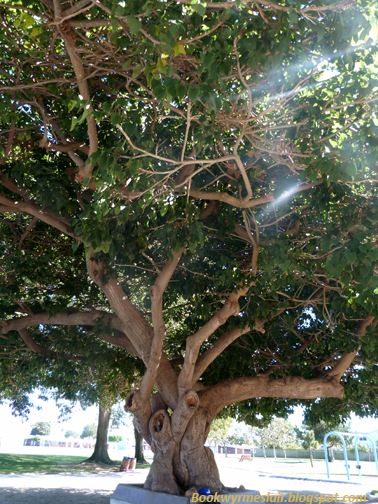
It's got a good selection of trees, even one, nice, central, twisty character tree (there's even a bench, of sorts, around it). There are at least five kinds of trees of different sizes (I'm starting to think of them as "the usual suspects; maybe one of these days I should try calling the park department again to find out just exactly what they are called), so there are plenty of places for the eye to rest and the view doesn't get monotonous.
Also, some of the trees had really great "toes," so I'd give Perry Park a high mark on the "trees with character" section, if I were giving marks.

The critter count was actually slightly higher than average. Not way up there--I wouldn't visit Perry to watch birds, for example, but I scuffed up plenty of small moths and flying creatures as I walked, by which unscientific method I'd say the park has more small life than the average area around it, and more than many of the other pocket parks, though that may not be entirely fair to them as I think I gave Perry's small life more attention than I gave, say Drew. There were some interesting gnats, spiders, ants--enough to keep a kid (or me) busy, but no special concentration, and, at least on that day, no dragonflies or larger butterflies.
I saw few non-bugs, though a squirrel in the nearby neighborhood makes me think they probably do show up.
As is fairly usual, the landscaping isn't particularly critter-friendly. The only available water was a large puddle due to recent rain, and there were no ragged edges for anything to hide in or ripening grass (or other greenery) for them to eat.
Picnic tables: Yes, there are picnic tables. I'd be surprised if the shade ever hits either of them, though (I note the website claims one is "in partial shade," so maybe sometimes a few leaves worth reaches it).

Bathrooms: No.
Water fountains: No.This is probably just as well, since the parks that have had water fountains haven't really had water fountains I'd drink from.
Playground Equipment: Perry Park has the standard setup with the yellow slide and all. Also swings for both tots and older kids.
Sports stuff: They do have soccer goals set up. There were no nets, but I'm no expert on this. You may have to ask ahead of time or something.
Parking: Streetside.
Worth visiting for its own sake? Not unless you're a park aficionado. It's great for the school kids and nice for the neighborhood, but there's nothing that makes this park stand out among parks.
Friday, November 18, 2011
The Sorcerer's Apprentice, a Review
That was way more fun than I expected.
Sure, The Sorcerer's Apprentice is a fluffy little film without a thought in its little head, but it's a fun fluffy little film.
Things I liked about the film
Things I didn't like: Bathazar's hair. Ok, he's busy training a new apprentice and saving the world and all, but Dave does keep insisting on going out on dates and things, so there's time for a quick shave and a stop by the mirror with a hairbrush and maybe some scissors.
So the Ayes have it.
Disney's Sorcerer's Apprentice (2010) is a fun, fluffy, thoughtless film hat never pretends to be anything else. I may never watch it again, but it was worth watching once.
Sure, The Sorcerer's Apprentice is a fluffy little film without a thought in its little head, but it's a fun fluffy little film.
Things I liked about the film
1) It was fun and funny. Lots of people forget how to be fun when they make movies.
2) Dave is a nerd. He stays a nerd through the entire movie. Other than a brief worry that he won't be able to impress Becky, he seems quite happy being a nerd and resists his roommates not-very pressing attempts to change him. His science skills comes in handy by the end as they combine quite nicely with magic--and hurray for physics and magic being compatible!.
4) Dave has at least one good friend willing to drop everything to help him, even when the request is really strange. There's no nonsense about "learning who your real friends are" or making new ones due to new-found confidence, or anything else. I suspect this is partly to leave more room for sorcerer's duels, but the end result is satisfactory. I'm a little burned out on nerdy/geeky people secretly longing to be cool and thus betraying their real friends for the (invariably shallow and thoughtless) cool people before coming to their senses. This time, the friendship is already there and to be counted on.
5) Becky likes Dave as he is, as a nerd.
6) Tesla coils! Musical Tesla coils! In a subway. It is entirely possible that I would love the movie for that alone.
7) Dancing mops. They aren't as impressive as the Tesla coils, but they are clearly enjoying being alive and are in no hurry to let Dave stop the games. Again, they might make the movie worth watching all on their lonesome.
8) The Sorcerer's Apprentice is the first movie I've seen in a long time (maybe ever?) where the heroes seem to be having as much fun as the villains. Sure, Balthazar mumbles something about responsibility, but he clearly enjoys changing the appearance of his car, bringing gargoyles to life, striding forward with dramatically billowing coat, and etc. When was the last time anyone other than the Evil Emperor got to have this much fun throwing lightning?
It takes Dave a little while to get the hang of things, but by the end, he's happily summoning metal eagles as well.
2) Dave is a nerd. He stays a nerd through the entire movie. Other than a brief worry that he won't be able to impress Becky, he seems quite happy being a nerd and resists his roommates not-very pressing attempts to change him. His science skills comes in handy by the end as they combine quite nicely with magic--and hurray for physics and magic being compatible!.
4) Dave has at least one good friend willing to drop everything to help him, even when the request is really strange. There's no nonsense about "learning who your real friends are" or making new ones due to new-found confidence, or anything else. I suspect this is partly to leave more room for sorcerer's duels, but the end result is satisfactory. I'm a little burned out on nerdy/geeky people secretly longing to be cool and thus betraying their real friends for the (invariably shallow and thoughtless) cool people before coming to their senses. This time, the friendship is already there and to be counted on.
5) Becky likes Dave as he is, as a nerd.
6) Tesla coils! Musical Tesla coils! In a subway. It is entirely possible that I would love the movie for that alone.
7) Dancing mops. They aren't as impressive as the Tesla coils, but they are clearly enjoying being alive and are in no hurry to let Dave stop the games. Again, they might make the movie worth watching all on their lonesome.
8) The Sorcerer's Apprentice is the first movie I've seen in a long time (maybe ever?) where the heroes seem to be having as much fun as the villains. Sure, Balthazar mumbles something about responsibility, but he clearly enjoys changing the appearance of his car, bringing gargoyles to life, striding forward with dramatically billowing coat, and etc. When was the last time anyone other than the Evil Emperor got to have this much fun throwing lightning?
It takes Dave a little while to get the hang of things, but by the end, he's happily summoning metal eagles as well.
Things I didn't like: Bathazar's hair. Ok, he's busy training a new apprentice and saving the world and all, but Dave does keep insisting on going out on dates and things, so there's time for a quick shave and a stop by the mirror with a hairbrush and maybe some scissors.
So the Ayes have it.
Disney's Sorcerer's Apprentice (2010) is a fun, fluffy, thoughtless film hat never pretends to be anything else. I may never watch it again, but it was worth watching once.
Thursday, November 17, 2011
Lake Park Knobby Tree
I'm not sure this tree doesn't decide to walk around the neighborhood at nights. The only surprise is it gets back to place during the day.


Wednesday, November 16, 2011
The Invention of Hugo Cabret and Wonderstruck by Brian Selznick, a dual review
Thanks to for the Bookphile for bringing The Invention of Hugo Cabret and Wonderstruck to my attention. Both are beautiful, unique works, novels "in words and pictures" as the subtitle to each says.
Each book intersperses the text with several pages of careful cross-hatched drawings and, in the case of Hugo Cabret, pictures from early movies, that continue the story being told in the text. The picture style is cinematic, often zooming in to a close-up over the course of several pages, giving the full panorama before showing the single person or image that matters.
The Invention of Hugo Cabret tells the story of a young boy who struggles to repair a broken automaton his father had found shortly before he died. The boy, Hugo, is orphaned and living in the train station, keeping the clocks going as best he can while he works on his father's find. In order to continue his work he steals clockwork toys from a booth in the train. When he is caught, he is given a job cleaning and working there and begins to form a friendship with the toy-seller's granddaughter and begins to share her love of the movies. Meanwhile, he still needs to fix the mysterious automaton and find a way to live.
To tell more would be to spoil some of the lovely parts of the book. It unfolds slowly to a 99.9% satisfying end.
That .01%? I couldn't quite believe the new automaton at the end. It's a minor matter, and I hate quibbling, but I just couldn't. Not quite. That should not stop anyone from reading the book, however.
Wonderstruck relies even more heavily on pictures than does The Invention of Hugo Cabret. In fact, while it would be just possible to follow Hugo Cabret's story without the pictures, it would be completely impossible to read Wonderstruck without them. Rose's half the story is told in pictures and only in pictures. I felt no lack of words when I was in her world.
In Wonderstruck, the newly orphaned Ben is living with his aunt, uncle, and cousins in their cabin. While there is no lack of love in his new home, he is lonely and grieving for his mother. Finding an old address in a book of hers, the first clue he has had to his father's identity, Ben sets off to find him, taking refuge for a time in an old museum.
Fifty years in Ben's past, Rose watches silent films and clips out pictures of a film star from magazines. Desperate to escape from her over-protective father, who keeps her close because she is deaf, she runs away to the city to find freedom, also taking refuge for a time in the museum.
Wonderstruck is the second of Selzinick's novels in words and pictures, and it benefits from his work on Hugo Cabret. It feels steadier, as though the author is now sure people will follow his work, and he is able to tell Rose's half in silence. As good as Hugo Cabret was, this is better. Each book deals with finding friends, family, and a place to belong, and the use of art in finding a path through the world. Both books also have that elusive, unquantifiable element: A sense of wonder. Highly recommended.
Each book intersperses the text with several pages of careful cross-hatched drawings and, in the case of Hugo Cabret, pictures from early movies, that continue the story being told in the text. The picture style is cinematic, often zooming in to a close-up over the course of several pages, giving the full panorama before showing the single person or image that matters.
The Invention of Hugo Cabret tells the story of a young boy who struggles to repair a broken automaton his father had found shortly before he died. The boy, Hugo, is orphaned and living in the train station, keeping the clocks going as best he can while he works on his father's find. In order to continue his work he steals clockwork toys from a booth in the train. When he is caught, he is given a job cleaning and working there and begins to form a friendship with the toy-seller's granddaughter and begins to share her love of the movies. Meanwhile, he still needs to fix the mysterious automaton and find a way to live.
To tell more would be to spoil some of the lovely parts of the book. It unfolds slowly to a 99.9% satisfying end.
That .01%? I couldn't quite believe the new automaton at the end. It's a minor matter, and I hate quibbling, but I just couldn't. Not quite. That should not stop anyone from reading the book, however.
Wonderstruck relies even more heavily on pictures than does The Invention of Hugo Cabret. In fact, while it would be just possible to follow Hugo Cabret's story without the pictures, it would be completely impossible to read Wonderstruck without them. Rose's half the story is told in pictures and only in pictures. I felt no lack of words when I was in her world.
In Wonderstruck, the newly orphaned Ben is living with his aunt, uncle, and cousins in their cabin. While there is no lack of love in his new home, he is lonely and grieving for his mother. Finding an old address in a book of hers, the first clue he has had to his father's identity, Ben sets off to find him, taking refuge for a time in an old museum.
Fifty years in Ben's past, Rose watches silent films and clips out pictures of a film star from magazines. Desperate to escape from her over-protective father, who keeps her close because she is deaf, she runs away to the city to find freedom, also taking refuge for a time in the museum.
Wonderstruck is the second of Selzinick's novels in words and pictures, and it benefits from his work on Hugo Cabret. It feels steadier, as though the author is now sure people will follow his work, and he is able to tell Rose's half in silence. As good as Hugo Cabret was, this is better. Each book deals with finding friends, family, and a place to belong, and the use of art in finding a path through the world. Both books also have that elusive, unquantifiable element: A sense of wonder. Highly recommended.
Tuesday, November 15, 2011
Harriett M. Wieder Regional Park, Huntington Beach
 I've been wanting to visit the Harriett M. Wieder Regional Park for a while now. It's four acres of pathways with a view over Bolsa Chica and it will, ultimately, connect to the Bolsa Chica State Beach. How awesome is that?
What with one thing and another, I didn't make it until this weekend. Not, perhaps, the best time to visit since it was raining steadily for a good part of the day and had rained all night, making the paths unsuitable for walking (sliding down, maybe; that might have worked).
 Clearly, I need to make another visit because, quibbles about the weather aside, the park looks very promising. I enjoy parks that allow for bird and bug watching, and there looks to be plenty of habitat. Even in the rain, there were a lot of sparrows out by the side of the road. With only half a mile of trail (as yet), it's not going to turn into a favorite exercise spot, but as a place to visit and watch the wildlife, it may well be worth paying attention to. Also, I think I'd like to see the view under more propitious circumstances. I mean, it was nice, in a gloomy, rain-soaked sort of way, but it takes sun to really bring out the sparkle.
I have to say, the playground does look good, too. It's unique among the OC playgrounds (at least, the ones I've seen so far), and both the older and younger kids side have a lot of areas for climbing, sliding, and swinging. Actually, kids could play on this particular playground even in the rain (if their mothers didn't mind them getting wet, that is) because it is paved with that lovely, bouncy stuff ("rubberizing surface" according to the OC Parks website) that I wish would show up more on adult exercise surfaces, like sidewalks.
Oh, and there is plenty of parking. At least, it was nearly empty the day I was there, but given the park's slightly out of the way location, I doubt it's ever packed. It may eventually link up with the Bolsa Chica State Beach, but it hasn't done so now, and even then, it will be a bit far for the surfers to cart their boards all the way from the parking lot to the beach.
 There are plenty of nice trees, too, including a few that, oddly, have plastic sprinklers running right up to their bases.

Monday, November 14, 2011
Once Upon a Time: The Price of Gold, a Review
The Price of Gold was, once again, gold. I'm really enjoying this show, and I hope they can keep this up.
Again, the focus is on interpersonal relationships and how they have been affected by the move into our world.
This time, the flashback reveals that Cinderella was not sent to the ball by her fairy godmother. Instead, Rumplestiltskin killed the fairy godmother and took her place. Cinderella was so desperate to escape her life of drudgery that she accepted the substitution fairly quickly and signed a deal with Rumplestiltskin: He'd get her to the ball, she'd pay him back in some unspecified way at some point in the future.
This is Rumplestiltskin we're talking about: In return for providing gold, he wants Cinderella's first child. She doesn't want to give it to him, and with the help of her husband, Prince Thomas, and Snow White's husband, they set a trap. Rumplestiltskin is imprisoned, but he warns that, unless his price is paid, Cidnerella will never see Prince Thomas again.
In the Maine world, Cinderella is Ashley, an unmarried young mother about to give birth. One thing has not changed: She has still signed a contract with Gold agreeing to give up her baby in return for money. Trying to leave the city, she is brought back by Emma, who in turn makes an agreement with Gold: Cinderella keeps her baby and is reunited with her prince, and Emma will owe him a favor.
Not even Henry, who has contrived to travel with her, warns her against this. So--oops. Emma's won a short-term victory, but what is it going to cost?
I do like Rumpelstiltskin as a villain. He seems so careful about covering all the angles in a bargain and so open about his machinations. I wonder, though, is he telling the truth when he says that all magic has a price? If so, what price is he paying? And, how can he be defeated? This is going to be very important as the story moves on--say, a season or three down the line. It is possible that it's as simple as knowing his real name (which, then, can't be Rumpelstiltskin since everyone in the fairy tale world knows it), since the guard mentioned names having power back in the pilot. However, that's long-term stuff, so we'll see.
As far as Emma's mistake: I like the fact that it's a very in-character mistake. It doesn't seem likely that her upbringing gave her much exposure to fairy tales, and she doesn't really believe yet that she's living in one, not even one gone wrong, so shes' not thinking in terms of promises being absolute, unbreakable, and unpredictable. Also, she's vulnerable to families in need and so just might have made that promise anyway.
The sour note in this comes with Regina and the sheriff. I really, really hope the show is not going to start focusing to much on who is sleeping with whom. On the one hand, I like the idea that deputizing Emma might be part of Regina's long-term plan; I'd like to see the queen as a capable plotter in her own right. On the other... who is sleeping with whom can get so tiresome. On the whole, I hope that what we saw was careful misdirection with the camera, not the beginnings of some strange triangle with the sheriff, Regina, and Emma.
Until next week!
___
As of this writing, several episodes, including The Price of Gold, are up on hulu. Actually, they're up on ABC as well, but on the whole, I've found hulu slightly easier to stream than any of the networks.
Again, the focus is on interpersonal relationships and how they have been affected by the move into our world.
This time, the flashback reveals that Cinderella was not sent to the ball by her fairy godmother. Instead, Rumplestiltskin killed the fairy godmother and took her place. Cinderella was so desperate to escape her life of drudgery that she accepted the substitution fairly quickly and signed a deal with Rumplestiltskin: He'd get her to the ball, she'd pay him back in some unspecified way at some point in the future.
This is Rumplestiltskin we're talking about: In return for providing gold, he wants Cinderella's first child. She doesn't want to give it to him, and with the help of her husband, Prince Thomas, and Snow White's husband, they set a trap. Rumplestiltskin is imprisoned, but he warns that, unless his price is paid, Cidnerella will never see Prince Thomas again.
In the Maine world, Cinderella is Ashley, an unmarried young mother about to give birth. One thing has not changed: She has still signed a contract with Gold agreeing to give up her baby in return for money. Trying to leave the city, she is brought back by Emma, who in turn makes an agreement with Gold: Cinderella keeps her baby and is reunited with her prince, and Emma will owe him a favor.
Not even Henry, who has contrived to travel with her, warns her against this. So--oops. Emma's won a short-term victory, but what is it going to cost?
I do like Rumpelstiltskin as a villain. He seems so careful about covering all the angles in a bargain and so open about his machinations. I wonder, though, is he telling the truth when he says that all magic has a price? If so, what price is he paying? And, how can he be defeated? This is going to be very important as the story moves on--say, a season or three down the line. It is possible that it's as simple as knowing his real name (which, then, can't be Rumpelstiltskin since everyone in the fairy tale world knows it), since the guard mentioned names having power back in the pilot. However, that's long-term stuff, so we'll see.
As far as Emma's mistake: I like the fact that it's a very in-character mistake. It doesn't seem likely that her upbringing gave her much exposure to fairy tales, and she doesn't really believe yet that she's living in one, not even one gone wrong, so shes' not thinking in terms of promises being absolute, unbreakable, and unpredictable. Also, she's vulnerable to families in need and so just might have made that promise anyway.
The sour note in this comes with Regina and the sheriff. I really, really hope the show is not going to start focusing to much on who is sleeping with whom. On the one hand, I like the idea that deputizing Emma might be part of Regina's long-term plan; I'd like to see the queen as a capable plotter in her own right. On the other... who is sleeping with whom can get so tiresome. On the whole, I hope that what we saw was careful misdirection with the camera, not the beginnings of some strange triangle with the sheriff, Regina, and Emma.
Until next week!
___
As of this writing, several episodes, including The Price of Gold, are up on hulu. Actually, they're up on ABC as well, but on the whole, I've found hulu slightly easier to stream than any of the networks.
Sunday, November 13, 2011
Grimm: Beeware, a Review
Ah yes, Beeware, the punnily titled episode in which Nick finally does some detecting, we meet the worlds' worst best communicators, and the tradition of needlessly cryptic warnings is rigorously kept.
I continue to like the idea of Grimm without being attracted to its execution. Nick is still reading as painfully generic, and sadly, so is his partner (Hank?) and the uniformed-guy (Sergeant? Somebody) who provides them with information. So, sadly, is Juliette, though she got one reasonably amusing line--addressed to the wrong person(1).
The bright spot: It is, finally, looking a little bit at the detective side of things: Nick and his partner are investigating two murders by bee-venom carried out during flash mobs.
Of course, the murderer turns out to be a fairy tale creature, and Monroe turns up very briefly to provide some encyclopedic information: The murderer is one of a group of beings called mellifera, whose main ability is to communicate.
Nick figures out that there is a third planned victim, also a fairy tale creature, this time it is Adelind, the same hexenbiest who tried to kill his aunt earlier. He is now responsible for protecting her from her would-be attackers.
And this is where the story starts to implode: No one tells anyone anything, even when it would make sense to do so.
Nick recognizes Adelind, but for no reason at all, does not tell either Renard or his partner. This is the woman who tried to kill his aunt and him. The fact that she is a hexenbiest does not, so far as Nick knows, have to intrude on the police aspect of it. I can't say whether or not this secrecy is in character because I don't know yet that Nick has a character.
Then the mellifer prove to be very poor communicators after all. Nick catches up with the lead (queen?) mellifer while she is trying to kill Adelind. Despite having an entire room full of bees at her command, the mellifer is trying to stab Adelind with a syringe while trying to persuade Nick to let her. As the women fight, she explains that the hexenbiests she had been persecuting her and her fellows in order to keep them from warning the Grimms, and so Nick should just stand aside (3). After fumbling with his gun for a while and dodging curtains of bees, Nick opts to shoot her rather than let her kill Adelind.
Nowhere during the rather long conversation does she actually give this all-important warning, not until she is dying, at which point she manages several sentences all of which add up to letting Nick know that "He" is coming and Nick should "be prepared." What is wrong with "John Black is coming. He'll be wearing a red jacket, and he'll be trying to steal your soul"? Or some other, similar, clearly-worded message?
Oh, and Nick gets stung at the end. Guess he just made a whole host of new enemies. Oops.
___
(1) Really: Wouldn't that scene about bee stings and dogs have worked better with Monroe? Wouldn't it have been more likely with Monroe? I mean, why was Hank going to his partner's fiancee, a vet, for first aid instead of stopping by a clinic or something? As an aside, I find myself wondering: Why is Monroe helping Nick at all? In the first case, he had some motive: There was a girl whose life was immediately in danger, and he, arguably, had some personal stake in it, since it was his species causing the mischief. What's his motive now? He doesn't particularly like Grimms as a race. Monroe remains a bright spot in the show, but I'd like to know why he's hanging around with the plastic people.
(2) By the next day, so far, but it's anyone's guess whether it will stay that way. Stations have a tendency to make deals with iTunes etc. that push the airtime back later. Whether that will be true of Grimm or not, I don't know.
(3) Let me repeat: This woman has an entire room full of bees at her command. All she needs to do is have them sting Adelind and then she and Nick can chat cozily. No one would believe him for one minute if he tried to explain that she'd used the bees as a murder weapon.
I continue to like the idea of Grimm without being attracted to its execution. Nick is still reading as painfully generic, and sadly, so is his partner (Hank?) and the uniformed-guy (Sergeant? Somebody) who provides them with information. So, sadly, is Juliette, though she got one reasonably amusing line--addressed to the wrong person(1).
The bright spot: It is, finally, looking a little bit at the detective side of things: Nick and his partner are investigating two murders by bee-venom carried out during flash mobs.
Of course, the murderer turns out to be a fairy tale creature, and Monroe turns up very briefly to provide some encyclopedic information: The murderer is one of a group of beings called mellifera, whose main ability is to communicate.
Nick figures out that there is a third planned victim, also a fairy tale creature, this time it is Adelind, the same hexenbiest who tried to kill his aunt earlier. He is now responsible for protecting her from her would-be attackers.
And this is where the story starts to implode: No one tells anyone anything, even when it would make sense to do so.
Nick recognizes Adelind, but for no reason at all, does not tell either Renard or his partner. This is the woman who tried to kill his aunt and him. The fact that she is a hexenbiest does not, so far as Nick knows, have to intrude on the police aspect of it. I can't say whether or not this secrecy is in character because I don't know yet that Nick has a character.
Then the mellifer prove to be very poor communicators after all. Nick catches up with the lead (queen?) mellifer while she is trying to kill Adelind. Despite having an entire room full of bees at her command, the mellifer is trying to stab Adelind with a syringe while trying to persuade Nick to let her. As the women fight, she explains that the hexenbiests she had been persecuting her and her fellows in order to keep them from warning the Grimms, and so Nick should just stand aside (3). After fumbling with his gun for a while and dodging curtains of bees, Nick opts to shoot her rather than let her kill Adelind.
Nowhere during the rather long conversation does she actually give this all-important warning, not until she is dying, at which point she manages several sentences all of which add up to letting Nick know that "He" is coming and Nick should "be prepared." What is wrong with "John Black is coming. He'll be wearing a red jacket, and he'll be trying to steal your soul"? Or some other, similar, clearly-worded message?
Oh, and Nick gets stung at the end. Guess he just made a whole host of new enemies. Oops.
___
(1) Really: Wouldn't that scene about bee stings and dogs have worked better with Monroe? Wouldn't it have been more likely with Monroe? I mean, why was Hank going to his partner's fiancee, a vet, for first aid instead of stopping by a clinic or something? As an aside, I find myself wondering: Why is Monroe helping Nick at all? In the first case, he had some motive: There was a girl whose life was immediately in danger, and he, arguably, had some personal stake in it, since it was his species causing the mischief. What's his motive now? He doesn't particularly like Grimms as a race. Monroe remains a bright spot in the show, but I'd like to know why he's hanging around with the plastic people.
(2) By the next day, so far, but it's anyone's guess whether it will stay that way. Stations have a tendency to make deals with iTunes etc. that push the airtime back later. Whether that will be true of Grimm or not, I don't know.
(3) Let me repeat: This woman has an entire room full of bees at her command. All she needs to do is have them sting Adelind and then she and Nick can chat cozily. No one would believe him for one minute if he tried to explain that she'd used the bees as a murder weapon.
Saturday, November 12, 2011
Lives of the Artists: Masterpieces, Messes (and What the Neighbors Thought) by Kathleen Krull, a Review
I listened to the audio version of Kathleen Kull 's Lives of the Artists, Masterpieces, Messes (and What the Neighbors Thought) read by Melissa Hughes and John C. Brown. It was an agreeable enough, but very much art history lite, and I found the selection of facts somewhat surprising. With less than ten minutes per artist (and Frieda Kahlo and Diego Rivera share a chapter),Krull has made sure to include what each artist ate and, often, what they wore. It seems an odd choice of priorities.
Despite the title's promise, there is very little on What the Neighbors Thought of most of these artists, good or bad, after the first tantalizing hint of speculation in the introduction. It's a pity, really, because grounding people in their time periods is one of the best ways to start understanding them.
It is a reasonable enough introduction to the subject, clips along at an easy, lively pace, and I certainly learned a few things. I am tempted by Kull's other audio books, as well. However, don't pick this up looking for deep analysis or insight. Possibly this would be better tackled in physical book format, too, as there's something strange about reading about art with no accompanying images.
Despite the title's promise, there is very little on What the Neighbors Thought of most of these artists, good or bad, after the first tantalizing hint of speculation in the introduction. It's a pity, really, because grounding people in their time periods is one of the best ways to start understanding them.
It is a reasonable enough introduction to the subject, clips along at an easy, lively pace, and I certainly learned a few things. I am tempted by Kull's other audio books, as well. However, don't pick this up looking for deep analysis or insight. Possibly this would be better tackled in physical book format, too, as there's something strange about reading about art with no accompanying images.
Friday, November 11, 2011
Black and Tan Brownies, a recipe from Cooking Light
I recently read an older Cooking Light article on brownies and decided to try some of their recipes. The Chai Latte Brownies were a big hit.
The Black and Tan Brownies, which I made tonight, not so much so. I didn't get the bottom layer firm enough before pouring, so they're layered in some places and marbled in others, but that is something I could correct for next time,f there were to be a next time. The bigger problem is they're just too sweet, and I'm not particularly impressed by the texture. The lower layer, the tan, is nice and chewy. The upper layer, the chocolate, is cakey. I like chewey! Also, they only have half the chocolate of the Chai Latte or Bourbon Fudge Brownies since they only have the melted chocolate and no cocoa.
And, they just plain make too much. Thirty brownies? No thanks.
Next up? Bittersweet Brownies, maybe. Or perhaps I'll make the Chai Latte Brownies again. Those were good.
The Black and Tan Brownies, which I made tonight, not so much so. I didn't get the bottom layer firm enough before pouring, so they're layered in some places and marbled in others, but that is something I could correct for next time,f there were to be a next time. The bigger problem is they're just too sweet, and I'm not particularly impressed by the texture. The lower layer, the tan, is nice and chewy. The upper layer, the chocolate, is cakey. I like chewey! Also, they only have half the chocolate of the Chai Latte or Bourbon Fudge Brownies since they only have the melted chocolate and no cocoa.
And, they just plain make too much. Thirty brownies? No thanks.
Next up? Bittersweet Brownies, maybe. Or perhaps I'll make the Chai Latte Brownies again. Those were good.

Thursday, November 10, 2011
Once Upon a Time: Snow Falls, a Review
Snow Falls is another solid, entertaining episode in Once Upon a Time's developing series.
The show continues to set the stage for the conflict to come, moving the fairy tale story back in time to Snow White and Prince Charming's(1) first meeting and pushing the plot forward to the first real struggle between Emma and Regina in Storybrooke.
In Snow Falls, Emma and Regina make their first moves directly relating to the curse and breaking it. Emma has found a place in town and, with Henry's help, she and Mary Margaret have wake John Doe/David Nolan/Prince Charming, a step toward reuniting the separated pair. Regina countered by bringing in David's wife--if, that is, Kathryn is his wife. In the flashback, she shows up as his fiancee just prior to Snow and Charming's first meeting. How this relationship played out in Storybrooke is open to question. The interwoven stories and relationships kept the tale moving quite nicely.
The most promising points, however, came right at the end: Regina informed Emma that Storybrooke is "bigger than you know" and the teaser for next week introduces Cinderella. This means that, yes, more fairy tale characters and plot strands can move into the series, making for a much richer and more tangled storyline(2) and also leaving open the possibility of Emma winning some rounds in the ongoing battle. A good, long fight can be fun, but not if it consists solely of the heroes losing over and over and over again while the villain gloats(3). This way, there can be minor victories and defeats along the way, which is much more interesting.
I am, I admit, concerned by the introduction of the Rotten Fiancee/Wife. Bad Fiancees all-too-often are merely bad. They are often so shrill, unsuitable, and annoying that one wonders what possesses anyone to keep them around at all, much less stay engaged/married. So my inner alarm went off when she showed up in our world. It's early days yet, though. Kathryn/Annette has only just appeared. With luck and good writing, she could turn out to be a multifaceted character with her own agenda that may or may not line up with Regina's.
It will be interesting to learn just how much Regina remembers about being queen. She certainly remembers power, and she remembers hatred. Does she remember her former life? After all, she's trapped herself in Maine along with everyone else. And Rumpelstiltskin/Gold(4)--How much does he remember? What is he after?
The character writing continues to be strong, overall. Snow, in the backstory, slides a bit toward cliche from time to time, but we haven't found out yet what happened between her and the queen. I have a feeling that will be worth seeing. Regina remains a complicated character. Wicked, yes, but in a complicated, interesting way. Emma was almost hidden behind her, these last two episodes, but she has a strong enough personality to be able to carry the lead role comfortably. Henry, wonder of wonders, remains a likeable and believable precocious kid.
Things I hope to see:
More fairy tale characters (That's coming, so hurray!) and more of everyone's back story (almost certainly coming)
Fairy tale characters from different traditions. Right now, we've got the Grimm lot plus Pinocchio. There are tales Disney never touched, and a few of those characters could add some variety and interest.
A better sense of what and where fairy land--or whatever it is called--is in relation to here. I'd like some sort of name for it, too, just for convenience sake.
More Maleficent(5). If one Evil Queen is good...
More of the show. I'm glad it at least gets a full season. I like having a show that I want to watch at the earliest possible moment, while it's on.
__
(1)He has a name, you know.
(2)Just so long as the creators can keep track. I don't mind being lost myself--I kind of enjoy it--but I hate it when the creators have clearly lost control (Just how many basements did the Centre have in Pretender? Did anyone know? By the end, did anyone care?)
(3)See the most recent V for an example. Or, rather, don't. Not even the fact that Anna gloats wonderfully well saves the show.
(4)I'm still trying to get figure out how to deal with this two-name deal. It's not a problem watching the show. Writing about it, however, is a whole 'nother deal. Do I use both names? Or do I stick with the our-world name for Maine and the fairy tale name for--fairyland(?)--whatever-it-is the characters call their real world.
(5)Yep. They have Disney's permission to use the name--plus a few others you may have noticed along the way.
____
As of this writing, the episode is up on hulu. I'm guessing it'll be there for another month.
The show continues to set the stage for the conflict to come, moving the fairy tale story back in time to Snow White and Prince Charming's(1) first meeting and pushing the plot forward to the first real struggle between Emma and Regina in Storybrooke.
In Snow Falls, Emma and Regina make their first moves directly relating to the curse and breaking it. Emma has found a place in town and, with Henry's help, she and Mary Margaret have wake John Doe/David Nolan/Prince Charming, a step toward reuniting the separated pair. Regina countered by bringing in David's wife--if, that is, Kathryn is his wife. In the flashback, she shows up as his fiancee just prior to Snow and Charming's first meeting. How this relationship played out in Storybrooke is open to question. The interwoven stories and relationships kept the tale moving quite nicely.
The most promising points, however, came right at the end: Regina informed Emma that Storybrooke is "bigger than you know" and the teaser for next week introduces Cinderella. This means that, yes, more fairy tale characters and plot strands can move into the series, making for a much richer and more tangled storyline(2) and also leaving open the possibility of Emma winning some rounds in the ongoing battle. A good, long fight can be fun, but not if it consists solely of the heroes losing over and over and over again while the villain gloats(3). This way, there can be minor victories and defeats along the way, which is much more interesting.
I am, I admit, concerned by the introduction of the Rotten Fiancee/Wife. Bad Fiancees all-too-often are merely bad. They are often so shrill, unsuitable, and annoying that one wonders what possesses anyone to keep them around at all, much less stay engaged/married. So my inner alarm went off when she showed up in our world. It's early days yet, though. Kathryn/Annette has only just appeared. With luck and good writing, she could turn out to be a multifaceted character with her own agenda that may or may not line up with Regina's.
It will be interesting to learn just how much Regina remembers about being queen. She certainly remembers power, and she remembers hatred. Does she remember her former life? After all, she's trapped herself in Maine along with everyone else. And Rumpelstiltskin/Gold(4)--How much does he remember? What is he after?
The character writing continues to be strong, overall. Snow, in the backstory, slides a bit toward cliche from time to time, but we haven't found out yet what happened between her and the queen. I have a feeling that will be worth seeing. Regina remains a complicated character. Wicked, yes, but in a complicated, interesting way. Emma was almost hidden behind her, these last two episodes, but she has a strong enough personality to be able to carry the lead role comfortably. Henry, wonder of wonders, remains a likeable and believable precocious kid.
Things I hope to see:
More fairy tale characters (That's coming, so hurray!) and more of everyone's back story (almost certainly coming)
Fairy tale characters from different traditions. Right now, we've got the Grimm lot plus Pinocchio. There are tales Disney never touched, and a few of those characters could add some variety and interest.
A better sense of what and where fairy land--or whatever it is called--is in relation to here. I'd like some sort of name for it, too, just for convenience sake.
More Maleficent(5). If one Evil Queen is good...
More of the show. I'm glad it at least gets a full season. I like having a show that I want to watch at the earliest possible moment, while it's on.
__
(1)He has a name, you know.
(2)Just so long as the creators can keep track. I don't mind being lost myself--I kind of enjoy it--but I hate it when the creators have clearly lost control (Just how many basements did the Centre have in Pretender? Did anyone know? By the end, did anyone care?)
(3)See the most recent V for an example. Or, rather, don't. Not even the fact that Anna gloats wonderfully well saves the show.
(4)I'm still trying to get figure out how to deal with this two-name deal. It's not a problem watching the show. Writing about it, however, is a whole 'nother deal. Do I use both names? Or do I stick with the our-world name for Maine and the fairy tale name for--fairyland(?)--whatever-it-is the characters call their real world.
(5)Yep. They have Disney's permission to use the name--plus a few others you may have noticed along the way.
____
As of this writing, the episode is up on hulu. I'm guessing it'll be there for another month.
Wednesday, November 9, 2011

Tuesday, November 8, 2011
Huntington Beach Central Park After Rain
 The owl, sitting out in plain sight for once and not pretending to be a bit of tree.
 Coots gathered together enjoying a meal of--whatever it is coots eat.
 Trees after the rain.
Yep. This is one great park.
Monday, November 7, 2011
Once Upon a Time Will Get a Full Season
Oh good. It's been a while since I've liked a show enough to work on watching it when it airs, and I'm glad to see that it will continue.
Of course, I hope we'll get more, but a full season is a good start.
The preview for next week's show suggests they'll be bringing in "Cinderella" as well as "Snow White"; if they can continue bringing in new characters and new stories, they might manage to spread this out well.
What about last night's show? I liked it! Review coming soon.
Of course, I hope we'll get more, but a full season is a good start.
The preview for next week's show suggests they'll be bringing in "Cinderella" as well as "Snow White"; if they can continue bringing in new characters and new stories, they might manage to spread this out well.
What about last night's show? I liked it! Review coming soon.
Bartlett Park at Dusk
More rain means more water for Bartlett Park, Huntington Beach. It looked fairly dark and foreboding in the evening light, but the local wildlife did not seem to care. The ducks show no sign of leaving their new home, and a blue heron still hoped for an evening's snack.
A large raptor watched the proceedings from a tree down in the valley. I think it was a white-tailed kite, but it was too dark to see for sure, and I was not able to get a good picture. Hummingbirds and sparrows were also plentiful.


A large raptor watched the proceedings from a tree down in the valley. I think it was a white-tailed kite, but it was too dark to see for sure, and I was not able to get a good picture. Hummingbirds and sparrows were also plentiful.


Sunday, November 6, 2011
Grimm, Bears Will Be Bears, a Review
A story blending the police procedural and the fairy tale should not be this bland.
Bears Will Be Bears is a small step up from the pilot episode. The product placement has been toned down considerably to the more usual long, loving shots of gleaming items rather than the extensive name-brand referencing of last week.
Generic Cop, aka Nick, is still pretty much the fresh-faced, standard-issue honest cop. There's little else to say about him. Other characters remain equally bland. Beautiful fiancee has red hair. Dubious but supportive partner/best friend is dubious.
The exceptions to this rule are Monroe, the former Bad Wolf, and Aunt Maria. Bad Wolf is, I admit, a pretty common brand of snarky, but any glimmer of humor is welcome, and it is, at least, a more recent mold. Though--I do predict his "dark past" is going to come back to haunt him and Nick at some point, possibly in an interesting fashion, possibly not (I also suspect some variant of the line "I told you I used to be a murderer, what did you expect?" will come up. I rather hope it doesn't, but it's hard to see the writers resisting).
Aunt Marie had by far the most potential of the bunch. She seemed a person, and a fairly complex one at that, but, as she's dead, we'll never learn more about this librarian/monster-hunter/adoptive mother.
Like the pilot, the plot Bears Will Be Bears has a definite paint-by-numbers feel. The events happen, but there's little real energy behind them. It's a loose take on "Goldilocks," which I think was an unfortunate follow up to the pilot's "Little Red Riding Hood." Last week the show featured snarling wolves who hunt people; this week it featured snarling bears. If this is going to be a monster-of-the-week show, let it at least provide unique monsters!
In their favor, the bears had a better and more understandable motive than the Bad Wolf. He just didn't like red (Or was driven mad by it? Seems the race would have died out by now, if they really, literally could not help themselves around what is a very common color). The bears actually do have a culture and reason behind their actions, giving them some credibility and some slight indication of personality. The monster pairing, however, remains unfortunate.
So far, the overall bland feel of the show comes largely from the astonishingly poor use the show's creators have made of their source material. They are drawing from three powerful genres and doing little more than skimming off the top of any of them.
I know relatively little about the monster-hunter sub-genre, so I cannot comment too extensively on it. I will say this, though: I know there is a tradition of the monster-hunter being kept in the dark until the last possible moment (usually when he or she is confronting a monster), and Grimm is sticking to this--for no readily apparent reason. It seems this trait runs in the Grimm family. Why, then, are they not raised to it? Told the tales, trained in fighting and weaponry, and prepared for the day when their designated mentor dies? Also, while I'm at it: Archaic weapons are also a tradition, and one Marie apparently kept, also for no apparent reason. Plain lead bullets work just fine.
Police procedurals: I'm more into the detective story side of things, being more an inconsistent viewer of Masterpiece Theater, or at one point Monk than a CSI fan, but I thought they were supposed to feature actual detecting and shows of skill and mystery. Nick has now, twice, stumbled over the perpetrators, and just by coincidence, they've been monsters with fancy German names (Do they have a collective name, these beasts? The "Them" the Grimms hunt?). The intelligence and skill required has been negligible. There's never been any real chance that the perpetrator was an ordinary, evil human, nor has Nick been called on to use much of his training as a policeman. He's a homicide detective. Let's see him detect!
This leads us to fairy tales, which I do know, and which is what drew me to Grimm in the first place. Fairy tales are strange things, full of unexpected twists and a strange logic. Help comes from unexpected places, so does harm. Baba Yaga may show you the way to the next castle--or she might eat you. Or she might come into your house and count the spoons. The simpleton wins. The loudmouth wins. There are rules, but they are hard to keep. There are monsters and evil stepmothers and blessings from beyond the grave. They are horrible and wonderful and mysterious.
And Grimm is using them as a monster-trove.
Fair enough. They can be that, but what a waste.
__
For the moment, Bears Will Be Bears is up on Hulu. I'm guessing it'll be there for another month, but they haven't posted the schedule yet.
Bears Will Be Bears is a small step up from the pilot episode. The product placement has been toned down considerably to the more usual long, loving shots of gleaming items rather than the extensive name-brand referencing of last week.
Generic Cop, aka Nick, is still pretty much the fresh-faced, standard-issue honest cop. There's little else to say about him. Other characters remain equally bland. Beautiful fiancee has red hair. Dubious but supportive partner/best friend is dubious.
The exceptions to this rule are Monroe, the former Bad Wolf, and Aunt Maria. Bad Wolf is, I admit, a pretty common brand of snarky, but any glimmer of humor is welcome, and it is, at least, a more recent mold. Though--I do predict his "dark past" is going to come back to haunt him and Nick at some point, possibly in an interesting fashion, possibly not (I also suspect some variant of the line "I told you I used to be a murderer, what did you expect?" will come up. I rather hope it doesn't, but it's hard to see the writers resisting).
Aunt Marie had by far the most potential of the bunch. She seemed a person, and a fairly complex one at that, but, as she's dead, we'll never learn more about this librarian/monster-hunter/adoptive mother.
Like the pilot, the plot Bears Will Be Bears has a definite paint-by-numbers feel. The events happen, but there's little real energy behind them. It's a loose take on "Goldilocks," which I think was an unfortunate follow up to the pilot's "Little Red Riding Hood." Last week the show featured snarling wolves who hunt people; this week it featured snarling bears. If this is going to be a monster-of-the-week show, let it at least provide unique monsters!
In their favor, the bears had a better and more understandable motive than the Bad Wolf. He just didn't like red (Or was driven mad by it? Seems the race would have died out by now, if they really, literally could not help themselves around what is a very common color). The bears actually do have a culture and reason behind their actions, giving them some credibility and some slight indication of personality. The monster pairing, however, remains unfortunate.
So far, the overall bland feel of the show comes largely from the astonishingly poor use the show's creators have made of their source material. They are drawing from three powerful genres and doing little more than skimming off the top of any of them.
I know relatively little about the monster-hunter sub-genre, so I cannot comment too extensively on it. I will say this, though: I know there is a tradition of the monster-hunter being kept in the dark until the last possible moment (usually when he or she is confronting a monster), and Grimm is sticking to this--for no readily apparent reason. It seems this trait runs in the Grimm family. Why, then, are they not raised to it? Told the tales, trained in fighting and weaponry, and prepared for the day when their designated mentor dies? Also, while I'm at it: Archaic weapons are also a tradition, and one Marie apparently kept, also for no apparent reason. Plain lead bullets work just fine.
Police procedurals: I'm more into the detective story side of things, being more an inconsistent viewer of Masterpiece Theater, or at one point Monk than a CSI fan, but I thought they were supposed to feature actual detecting and shows of skill and mystery. Nick has now, twice, stumbled over the perpetrators, and just by coincidence, they've been monsters with fancy German names (Do they have a collective name, these beasts? The "Them" the Grimms hunt?). The intelligence and skill required has been negligible. There's never been any real chance that the perpetrator was an ordinary, evil human, nor has Nick been called on to use much of his training as a policeman. He's a homicide detective. Let's see him detect!
This leads us to fairy tales, which I do know, and which is what drew me to Grimm in the first place. Fairy tales are strange things, full of unexpected twists and a strange logic. Help comes from unexpected places, so does harm. Baba Yaga may show you the way to the next castle--or she might eat you. Or she might come into your house and count the spoons. The simpleton wins. The loudmouth wins. There are rules, but they are hard to keep. There are monsters and evil stepmothers and blessings from beyond the grave. They are horrible and wonderful and mysterious.
And Grimm is using them as a monster-trove.
Fair enough. They can be that, but what a waste.
__
For the moment, Bears Will Be Bears is up on Hulu. I'm guessing it'll be there for another month, but they haven't posted the schedule yet.
Saturday, November 5, 2011
Once Upon a Time: Review
I finally watched both the pilot episode and The The Thing You Love Most (both currently available on Hulu, though I don't know how long they'll be up as that's not posted. Five episodes at a time seems fairly standard, though, so I'd guess another month). Anyway, I really enjoyed them, and I'm looking forward to Snow Falls, the third episode, this Sunday.
The basic premise is that the Evil Queen from Snow White took her revenge on all the other fairy tale characters by exiling them to "someplace terrible" that is, our world. They do not remember their old lives, nor do they notice that time has stopped in their new town of Storybrooke. Only Henry, the adopted son of the mayor, Regina--the Evil Queen herself--suspects something is wrong, and he persuades his birth mother, Emma Swann, to come to town to try to save everyone. That's one strand of the story. The other strand, being told backward, are the events that led to the Evil Queen casting her curse in the first place.
Complicated? Yes. Also intriguing and full of fascinating characters. Emma Swann, who is probably Snow White and Prince Charming's daughter, has grown up without parents and supports herself as a bail bondsperson. She is very good at tracking down people who don't want to be found and, though out of her depth in the current situation, is stubborn enough, and already attached enough to Henry, to agree to spend a week in the town trying to sort things out. Henry is a likeable kid, determined to prove that his crazy claim is real. Rumplestiltskin aka Mr. Gold is devious, probably playing both sides, and looks to be all kinds of awesome. Even the Evil Queen has her, well, not exactly good--in fact, quite exactly not-good--um, multidimensional? aspects to keep her interesting.
Anyway, the interpersonal element is strong. The story element has a lot of potential; I'm enjoying the flash-back and present-day intertwining, and it will be interesting to see how making and breaking the curse plays out. There's the added fun of seeing the fairy tale characters (and I do love fairy tales) in new roles here in our world.
I'm also pleased by the show's apparent desire to focus on the possibility of happily-ever-after. I get tired of "darker and edgier" claims.
My one major doubt is that it is really hard to see how this is going to play out in a series format. I can see it easily working as a miniseries with a clear beginning, middle, and end and known length. A (potentially) multi-season show with no clear end in sight. That's going to be a lot harder. Still, it is off to a good, strong start.
Minor doubt? Not so much of a doubt as a gripe: There's a scene where Snow White (now a school teacher), is teaching her kids to build cages. She has some nice spiel about birds and freedom, and in the course of this lecture, puts out her hand. A bird hops onto it and then is released back out into the wild. My problem? They actually focus in on the bird and it's little hooked beak. It's not a wild bird. It is a parrot--either a lovebird or a parrotlet--and should not be being released to live in little birdhouses in Maine, where it will die in the winter. Totally unfair of me to gripe about it, and I love the show otherwise, but I hope they won't do that again!
The basic premise is that the Evil Queen from Snow White took her revenge on all the other fairy tale characters by exiling them to "someplace terrible" that is, our world. They do not remember their old lives, nor do they notice that time has stopped in their new town of Storybrooke. Only Henry, the adopted son of the mayor, Regina--the Evil Queen herself--suspects something is wrong, and he persuades his birth mother, Emma Swann, to come to town to try to save everyone. That's one strand of the story. The other strand, being told backward, are the events that led to the Evil Queen casting her curse in the first place.
Complicated? Yes. Also intriguing and full of fascinating characters. Emma Swann, who is probably Snow White and Prince Charming's daughter, has grown up without parents and supports herself as a bail bondsperson. She is very good at tracking down people who don't want to be found and, though out of her depth in the current situation, is stubborn enough, and already attached enough to Henry, to agree to spend a week in the town trying to sort things out. Henry is a likeable kid, determined to prove that his crazy claim is real. Rumplestiltskin aka Mr. Gold is devious, probably playing both sides, and looks to be all kinds of awesome. Even the Evil Queen has her, well, not exactly good--in fact, quite exactly not-good--um, multidimensional? aspects to keep her interesting.
Anyway, the interpersonal element is strong. The story element has a lot of potential; I'm enjoying the flash-back and present-day intertwining, and it will be interesting to see how making and breaking the curse plays out. There's the added fun of seeing the fairy tale characters (and I do love fairy tales) in new roles here in our world.
I'm also pleased by the show's apparent desire to focus on the possibility of happily-ever-after. I get tired of "darker and edgier" claims.
My one major doubt is that it is really hard to see how this is going to play out in a series format. I can see it easily working as a miniseries with a clear beginning, middle, and end and known length. A (potentially) multi-season show with no clear end in sight. That's going to be a lot harder. Still, it is off to a good, strong start.
Minor doubt? Not so much of a doubt as a gripe: There's a scene where Snow White (now a school teacher), is teaching her kids to build cages. She has some nice spiel about birds and freedom, and in the course of this lecture, puts out her hand. A bird hops onto it and then is released back out into the wild. My problem? They actually focus in on the bird and it's little hooked beak. It's not a wild bird. It is a parrot--either a lovebird or a parrotlet--and should not be being released to live in little birdhouses in Maine, where it will die in the winter. Totally unfair of me to gripe about it, and I love the show otherwise, but I hope they won't do that again!
Grimm: The Pilot, a review
Let's see, what was that about again? Oh, yeah. A girl wearing a pair of pink Nikes and listening to "Sweet Dreams" on her pink iPod goes running in the woods. She is killed by someone wearing Nike boots and her pink iPod, still playing the same song (by Eurythmics, as one cop tells another), is left in-camera. We never see her face until her roommate pulls out an iPhone to show us who she was. The iPhone gets plenty of screen time. So do the Nikes (both pairs), and the song plays again, more than once.
Oh, and, um, yeah, there's something about a fairly generic detective guy who finds out he's a monster hunter, a former murderer who has reformed,a kidnapped girl, and the hunt to find the killer/kidnapper.
The pilot also features generic-policeman's partner, product-placement guy (he gets to name things for us) and a wistful fiancee with long hair.
To be fair, dying mentor-woman (who tells generic-policeman about his heritage as monster-hunter) and reformed bad-wolf-person have some inklings of personality, but not nearly enough to pull this out of the "meh" category.
Yes, the product placement was that bad and the story surrounding the ads was that forgettable.
It wants to be a police procedural with fairy tale elements, which is a kind of cool idea, but when the products (did I mention the Iphone? And the Nikes?) are the most memorable aspects of a show, there are problems.
I'm sort of trying to convince myself to watch the second one, but... eh.
Oh, and, um, yeah, there's something about a fairly generic detective guy who finds out he's a monster hunter, a former murderer who has reformed,a kidnapped girl, and the hunt to find the killer/kidnapper.
The pilot also features generic-policeman's partner, product-placement guy (he gets to name things for us) and a wistful fiancee with long hair.
To be fair, dying mentor-woman (who tells generic-policeman about his heritage as monster-hunter) and reformed bad-wolf-person have some inklings of personality, but not nearly enough to pull this out of the "meh" category.
Yes, the product placement was that bad and the story surrounding the ads was that forgettable.
It wants to be a police procedural with fairy tale elements, which is a kind of cool idea, but when the products (did I mention the Iphone? And the Nikes?) are the most memorable aspects of a show, there are problems.
I'm sort of trying to convince myself to watch the second one, but... eh.
Friday, November 4, 2011
What to Do with a Fifty-Two Pound Pumpkin
What do you do when the Fall Festival is over and you're left with a big, beautiful, fifty-two pound pumpkin?
1) Look at a friend and impulsively say "Let's cook!"
2) Have a friend who is crazy enough to say "Sure!"
3) Spend an evening looking at recipes while your friend is doing the same thing at her place.
4) Get together and spend the day making:
Pumpkin Black Bean Soup
We had it for lunch along with the waffles. It was tasty! Leftovers are in both our fridges, and I expect to have it for dinner here.
Alterations and amendments: We neither of us had sherry handy, so we just put in some red wine. Ditto on the cheese; we did without at lunch, but dinner tonight is probably going to feature whatever cheese is in the fridge rather than the actual cheese called for.
Pumpkin waffles
 The pumpkin doesn't add much flavor but does make for a really good, soft, moist waffle. I know this because the following exchange occurred as we were sampling the first waffle:
My friend: These are tasty.
Me: Yes.
Pause.
You know what I forgot?
My friend: What?
Me: Pumpkin.
So then I added the puree to the rest of the waffle batter, and the results were impressive.
Chocolate Chip Pumpkin Bread
 No accidents or incidents marred the baking of this bread which we had with dinner and which I recommend whole-hardheartedly. As with the waffles, the pumpkin doesn't seem to add any flavor but does make for a softer bread. The combination of spices and chocolate is wonderful. Actually--one slight caveat--I know it adds calories, but next time, I'd probably use more chocolate chips.
Alterations and amendments: The recipe calls for canned pumpkin, but since the purpose of the exercise was to use the actual pumpkin sitting in front of us, we used the puree. It worked.
Pumpkin Cinnamon Struesel Buns The bread is very, very soft without having much butter. I may use this as my base for the annual cinnamon rolls this year since it's always a struggle to get a soft enough bun, and I have plenty of puree left.
Sugar-and-nutmeg pumpkin slices, a recipe courtesy of my sister who had her own pumpkin inundation a few days ago. This one is easy: Stack slices of pumpkin sprinkled with sugar, nutmeg, and cinnamon in the crockpot. Add a little water. Cover and leave on high for 4 hours or on low for 8, give or take. Serve as is or with additional sugar on the side.
 Pumpkin pie I haven't tasted it yet, but it really looked good when I took it out of the oven!
And pumpkin yeast bread using a recipe from The Bread Machine Gourmet. We didn't use the bread machine since both of us wanted loaves. We ended up with three beautiful loaves. They rose splendidly and baked to just the right shade of golden-brown, probably courtesy of the pumpkin. As with the cinnamon rolls, the bread is very soft without being high-butter, so I'd say this is a keeper, at least as long as I have pumpkin puree.
And, yes, I do have pumpkin puree, lots and lots of pumpkin puree. Both of us ended up with big containers full of pumpkin puree which we're now separating out and freezing in smaller containers for later, less intensive baking efforts.

And we didn't quite make it through the whole pumpkin for all of that. The last ten or so pounds are just going to have to go the way of all good things. The local squirrels may get a slice or two, but that's about it.
1) Look at a friend and impulsively say "Let's cook!"
2) Have a friend who is crazy enough to say "Sure!"
3) Spend an evening looking at recipes while your friend is doing the same thing at her place.
4) Get together and spend the day making:
Pumpkin Black Bean Soup
We had it for lunch along with the waffles. It was tasty! Leftovers are in both our fridges, and I expect to have it for dinner here.
Alterations and amendments: We neither of us had sherry handy, so we just put in some red wine. Ditto on the cheese; we did without at lunch, but dinner tonight is probably going to feature whatever cheese is in the fridge rather than the actual cheese called for.
Pumpkin waffles

My friend: These are tasty.
Me: Yes.
Pause.
You know what I forgot?
My friend: What?
Me: Pumpkin.
So then I added the puree to the rest of the waffle batter, and the results were impressive.
Chocolate Chip Pumpkin Bread

Alterations and amendments: The recipe calls for canned pumpkin, but since the purpose of the exercise was to use the actual pumpkin sitting in front of us, we used the puree. It worked.
Pumpkin Cinnamon Struesel Buns The bread is very, very soft without having much butter. I may use this as my base for the annual cinnamon rolls this year since it's always a struggle to get a soft enough bun, and I have plenty of puree left.
Sugar-and-nutmeg pumpkin slices, a recipe courtesy of my sister who had her own pumpkin inundation a few days ago. This one is easy: Stack slices of pumpkin sprinkled with sugar, nutmeg, and cinnamon in the crockpot. Add a little water. Cover and leave on high for 4 hours or on low for 8, give or take. Serve as is or with additional sugar on the side.
 Pumpkin pie I haven't tasted it yet, but it really looked good when I took it out of the oven!
 And pumpkin yeast bread using a recipe from The Bread Machine Gourmet. We didn't use the bread machine since both of us wanted loaves. We ended up with three beautiful loaves. They rose splendidly and baked to just the right shade of golden-brown, probably courtesy of the pumpkin. As with the cinnamon rolls, the bread is very soft without being high-butter, so I'd say this is a keeper, at least as long as I have pumpkin puree.
And, yes, I do have pumpkin puree, lots and lots of pumpkin puree. Both of us ended up with big containers full of pumpkin puree which we're now separating out and freezing in smaller containers for later, less intensive baking efforts.

And we didn't quite make it through the whole pumpkin for all of that. The last ten or so pounds are just going to have to go the way of all good things. The local squirrels may get a slice or two, but that's about it.
Subscribe to:
Posts (Atom)